Trending
Dice, or Farkle for the cultured among you, is a popular minigame in Kingdom Come: Deliverance 2. You'll find dice tables in practically every tavern across the game’s huge two maps, where locals are eager to test their luck against yours.
Farkle is a 1v1 game where you and your opponent take turns rolling dice for points. Your goal is to be the first player to reach the target score to claim victory and walk away with some extra groschen in your coin purse.

How to Play Dice in Kingdom Come: Deliverance 2
Farkle: The Basics
At the start of your turn, you roll six dice. Then, you pick out (WASD, E) the scoring dice based on whatever lucky or unlucky roll you land and set those aside to save your points. You can track scores in the bottom left corner of the screen. From here, you have two options:
Score and continue (F) to score the selected dice and roll the remaining ones;
Score and pass (Q) to score your points and end your turn.
If you’re bold enough to score and continue, you can continue rolling until you decide to stop and bank your points or until you bust — fail to roll a scoring die, which makes you lose all accumulated points. A bust happens when none of your dice form a valid scoring combination. And yes, you can bust on your very first roll.
Say you roll pairs of 2s, 3s, and 4s. That’s a bust because, unless you're rolling triples (or getting 1s and 5s), those numbers won’t score you anything. Below is a screenshot showing all possible scoring combos.
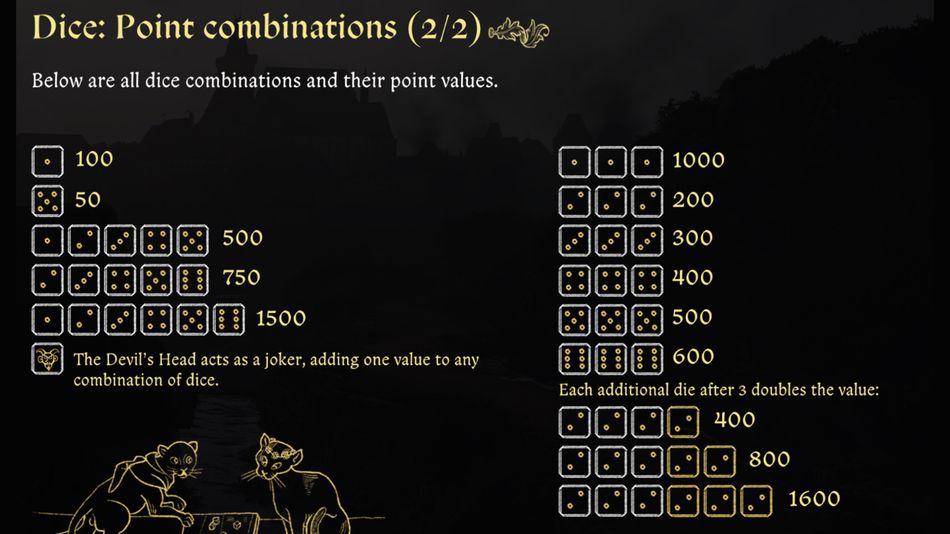
Farkle Example – Scoring, Turns and Busts
Here’s an example of how turns and busts work in Farkle, and sadly almost a 1/1 recreation of what actually happened to me.
- You roll six dice and get 1, 2, 2, 3, 4, 6. The only scoring die here is 1, worth 100 points. You score and continue, rolling the remaining five dice.
- Then you roll 2, 3, 4, 5, 6. That’s a straight worth 750 points. This brings you up to a total of 850. Since this clears your hand, you get to roll all six dice again.
- On the third roll, you land 5, 2, 2, 3, 3, 6. The only scoring die is 5, worth 50 points. You score it, bringing your total to 900, and roll the remaining five dice.
- You roll 1, 1, 3, 2, 2. You’ve got two 1s, which is a valid scoring combo because 1s don’t have to come in threes, but you take a risk and only score one 1, totalling 1000 points, then roll the last four dice.
- You roll 2, 2, 3, 3. Now that’s a bummer, and a bust. You lose all the 1000 points you have scored so far.
A super simplified guide would be to look for 1s and 5s, as they’re always scoring. Look for straights (1-5, 2-6, 1-6), and look for threes or more whatever the number. Busting wipes your score — if you’re in desperate need of points and down to three rolling dice after scoring, while risky, it can still pay off to roll, but rolling two very rarely pays off, so don’t be overly ambitious and learn when to stop.
Weighted Dice and the Badge System
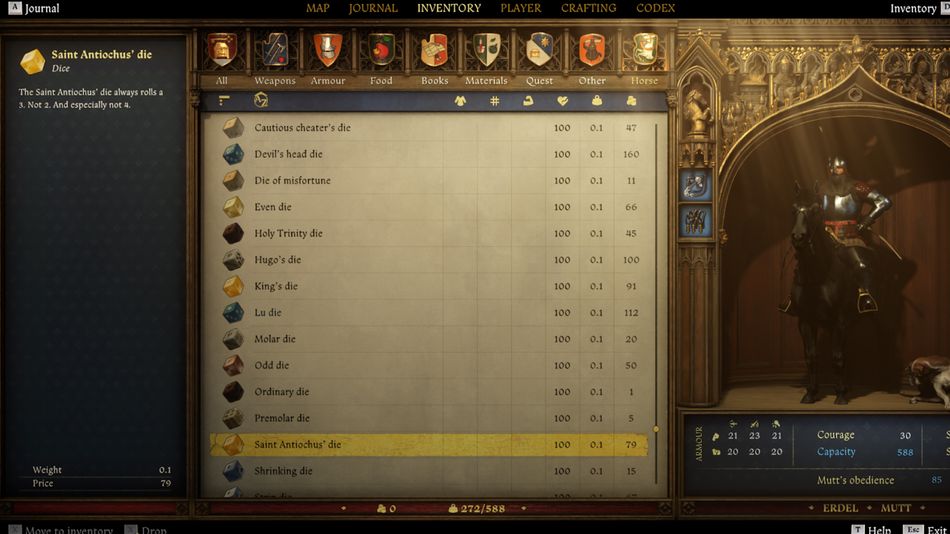
If you’ve got special weighted dice in your inventory, you can select them at the start of the minigame. Each type has its own unique properties, and you can find these dice scattered across the world hidden in chests, pickpocket them off unsuspecting targets, or buy from traders.
While the basic principles of dice remain the same as in Kingdom Come: Deliverance, this time around Warhorse Studios added a fresh twist to it with its new badge system. You can only use badges against an opponent with a matching tier: tin vs tin, silver vs silver, or gold vs gold. Before starting a game, you can select a badge from your inventory and check its special abilities in the description.
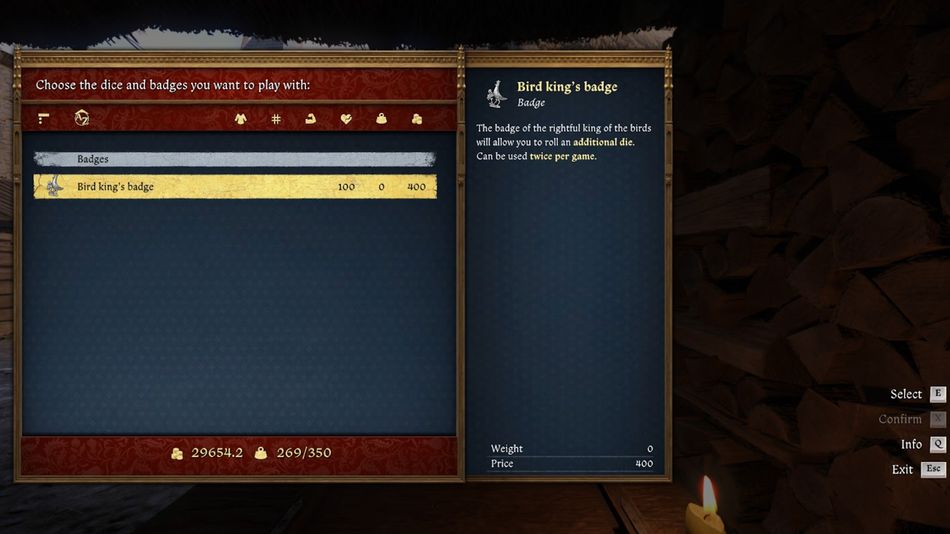
Each badge comes with its own unique properties that modify the standard rules of Farkle. If you’re playing with a badge, your available uses will be shown in the left corner below your name, and the number of gold icons will represent the number of times you can activate its ability.
Think carefully before using your badge, as timing can mean the difference between walking away with a heavier purse or drowning away your sorrows in whatever ale you can afford. But hey, fortune favours the brave.