Trending
I was always a big fan of Dante and his works ever since I was in high school, so when I got a chance to review a game that's built around a part of the Divine Comedy, I was very excited. I like to believe that everyone has at least heard about this work, either through the book or through the old Dante's Inferno game, which was a gem, to be honest. I'll gladly accept both.
Still, I wasn't sure what to expect when I booted the game up. The premise did sound interesting, but I was also worried that it might not turn out as good as I imagined it. When you love a source material this much, your expectations tend to climb pretty high, and that's a lot of weight to put on a game's shoulders.
The Alighieri's Circle: Dante's Bloodlines brings a narrative-driven experience, with no combat at all, so it's more or less a walking simulator with some puzzles. I personally was never a fan of those, but I was curious enough to try and keep going, because the game does know how to build an insanely good atmosphere.
There was ambition, there was love put into this game, but I'm just not sure whether it was enough.
Abandon all hope, ye who inherit this
I know that families can put burdens on their kids, but this game takes all of that to a whole new level.
Gabriele Alighieri, our protagonist, is a descendant of Dante himself, and his role is to make sure that all hell doesn't break loose...Quite literally. Every 33 years, a member of his bloodline has to go through something they call A Dive, where they enter hell, face their fears, and bind it once more so the world can continue to exist in harmony and all is well. Every member of Gabriele's family went through this, and it usually left them different people when they came back. Some lost a part of themselves, some their feelings, some their memories.
I did think it would be fun to be able to say you're a descendant of Dante, but then again, I don't think I'm okay with all this carrying-the-fate-of-the-world burden on your shoulders, so I think I'll pass.
The story is set in the 90s, and it starts off with Gabriele arriving at the Alighieri villa in Italy. After a phone call to his wife, Dalila, the adventure begins. His first job is to enter the crypt and make his way to Hell, but it's not all that simple, and right from the start the game throws you in for a search before you can actually go and save the world.
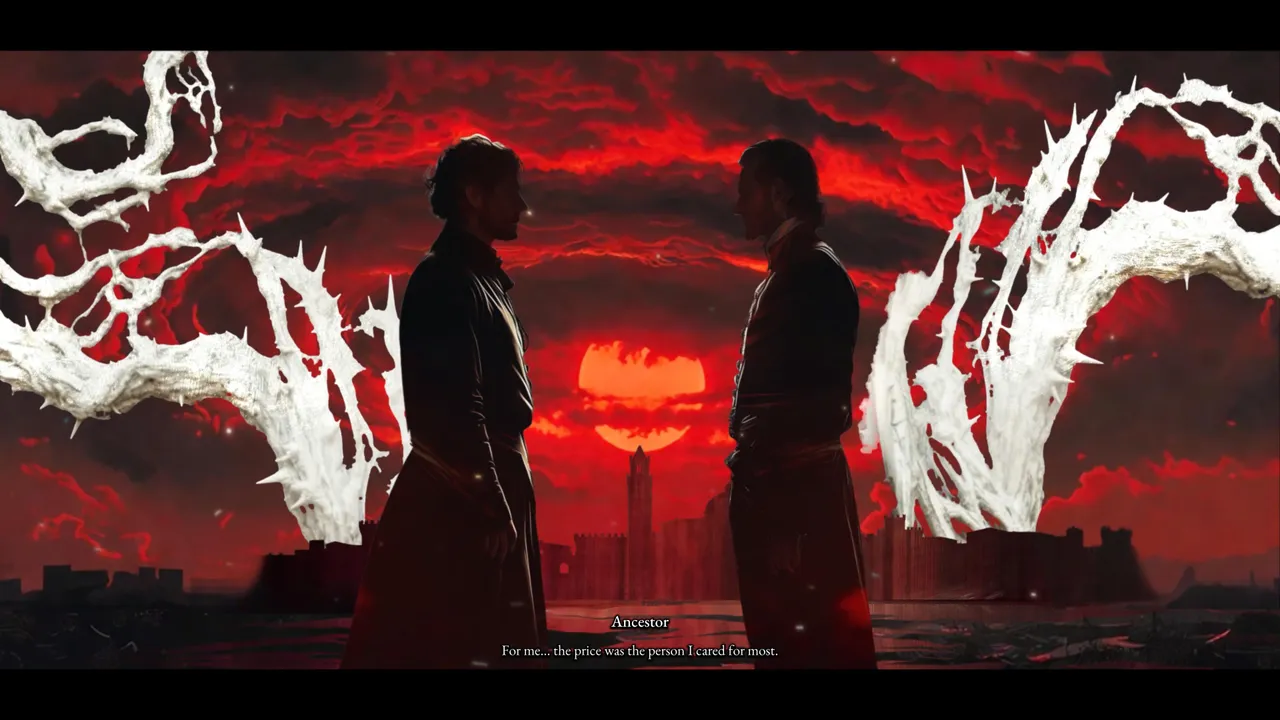
Gabriele isn't alone on this journey. As I've mentioned, every family member of his had to go through their own Dive, and when he finally gets to Hell, he will soon meet some sort of ancestors who will act as guardians, and one he won't be able to see, just hear his omnipresent voice. He will give him some tips, talk to Gabriele, and follow him down his destined path. Besides the Ancestor, this is more or less a very lonely experience, although you get to meet Charon, the ferryman of the River Acheron, which I found to be very neat.
The fact that the entire journey is tied to Gabriele's family makes it a very personal journey, and that somehow makes it all even harder, but it also connects it back to Dante and his own journey, which he intended to be very personal. His journey through Inferno, Purgatorio, and Paradiso was only his, as hell shows everyone their darkest fears, thoughts, and issues, and if any one of us ended up on this journey, Hell would mould itself to represent the things we are afraid of and become our own personal experience.
However, while this is a story about the world ending and the task of saving it falls on the shoulders of one man, I never really felt like Gabriele was all that emotionally involved in it. I feel like I would be passionate about the fact that I am the only person who can stop the world from ending; it's not like you're picking out which shirt to wear to work today. I wish that I felt the same determination and passion in Gabriele as I saw in Dante when he was moving mountains during his journey to find his loved one, Beatrice.
A stroll through hell
The gameplay is basically divided into two sections: exploring Gabriele's ancestral home and making your way through Hell. Usually, after you get the keys and open the portal to Hell, the gameplay loop consists of finding a trial, solving it, going back to the manor to talk to Dalila, and then rinsing and repeating it.
I wasn't really a fan of the gameplay loop. Every time I finished a trial, I had to make my way up the stairs to the fumoir where the phone was, so Gabriele could call his wife and then yap for a while. It felt almost like it broke me out of the immersion, as my focus was on his journey through hell and the puzzles, not a conversation between him and his wife. But hey, maybe your priorities will lie elsewhere. There were also sections where you'll have to walk a bunch and also crouch, which slowed the pace of the game even more.
As you walk through the villa, you'll see that the layout and the map are similar to Resident Evil . The corridors, the map, the movement, it all gave me that feeling. The map can be a bit confusing at times, although that might just be a skill issue on my part, as I've never played games like this.
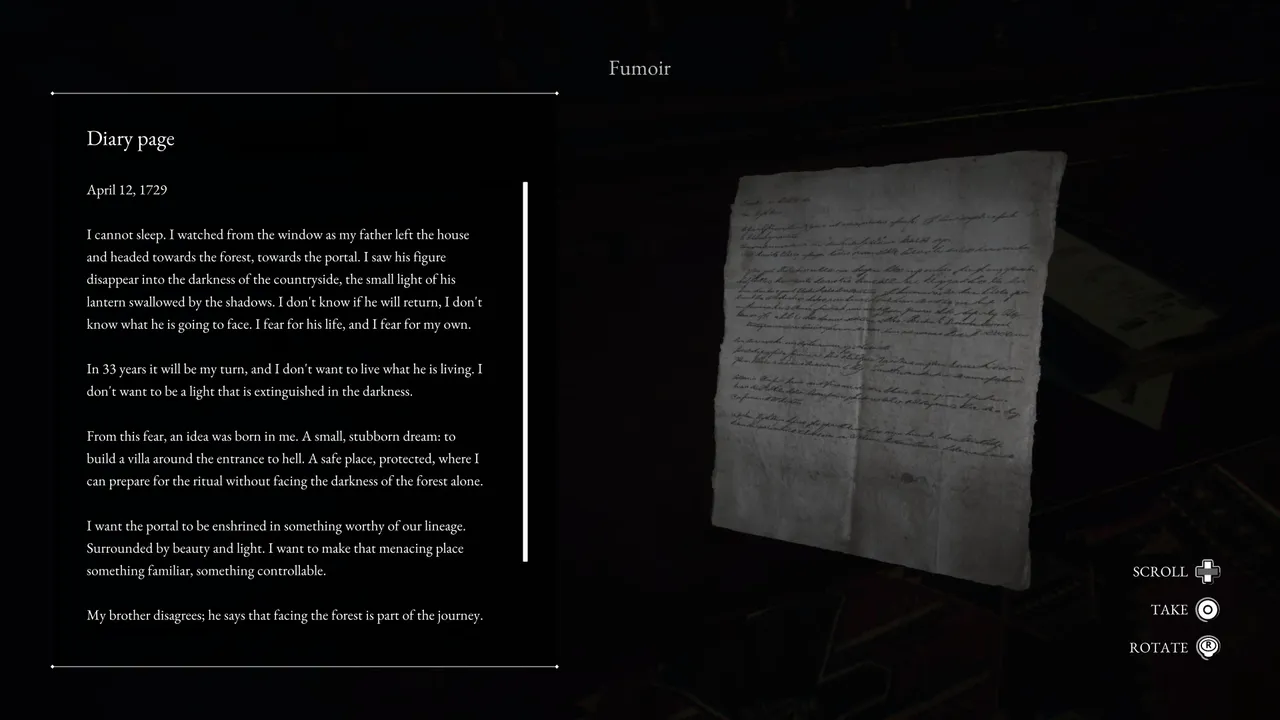
The manor itself is grand, but I feel like it wasn't used to its full potential, especially the basement and the crypt area. Besides the initial task of opening the portal, you don't really have much to do here. Yes, you need to go back to call your wife, and there are collectables and pages here and there, but besides that, there isn't really a lot of activity here. I did enjoy finding the collectables and pages, as they gave some insight into his family and the people that came after him.
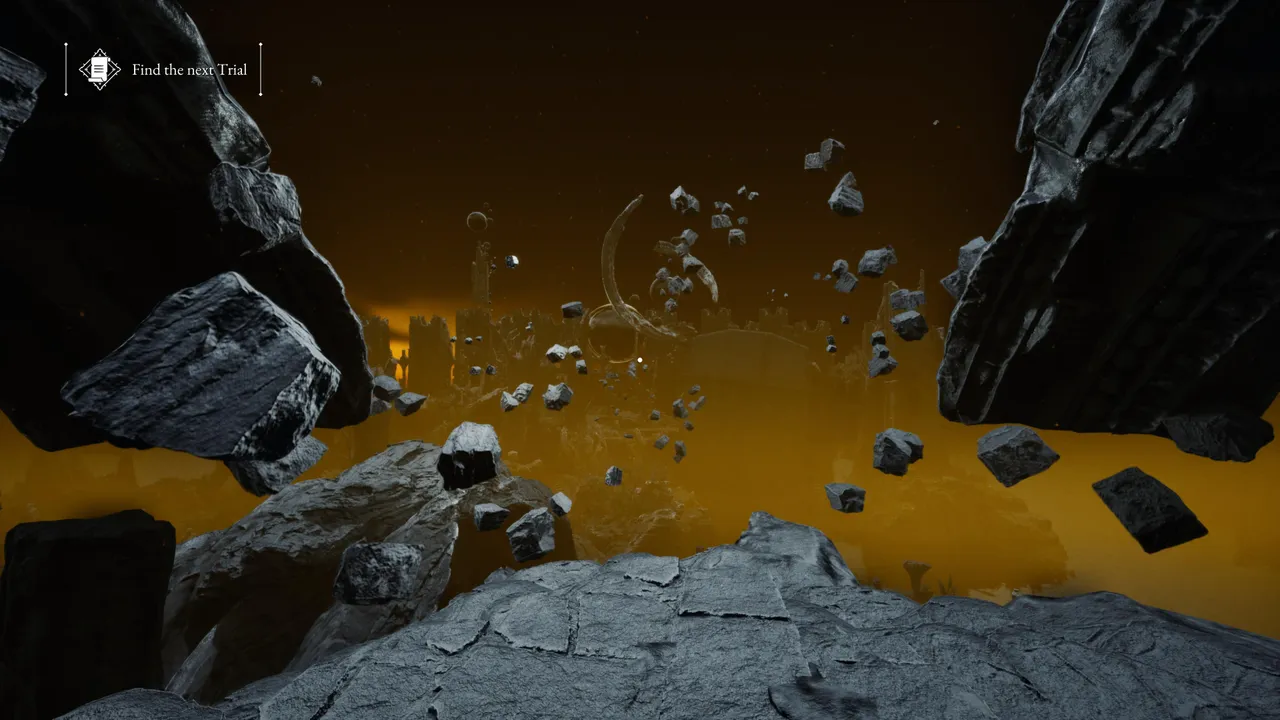
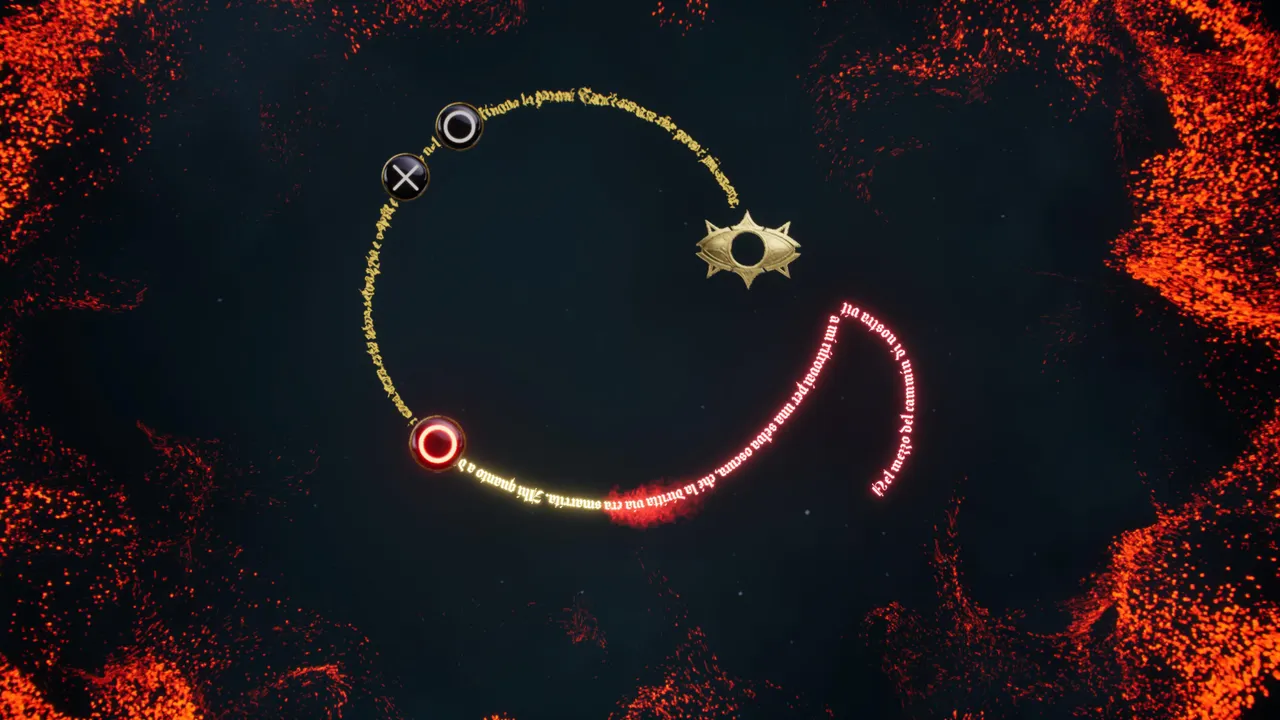
Once you're in the dive, you're mostly walking, talking to the Ancestor, and solving puzzles. The Dive isn't static; it moves and shifts every time you visit it, and there is also a mini-game when you're entering the portal, which is not too difficult.
Hell has three trials, which represent three pages of the book, one per chapter. These three trials are separated by smaller puzzles, and the game makes sure that you know when you have a major trial in front of you. All of them are logical: the first one demands attention to detail, the second one revolves around listening, while the third one - the most important one - focuses on memory. The trials aren't too hard, and while there are no hints, things are pretty self-explanatory, and you'll surely manage to get through them. That being said, I did feel like the third one felt a bit like trial and error, so prepare yourself for that too.
Speaking of the three pages, I can understand that 9 pages might be a bit much, but I felt like covering only three pages felt almost like having an unfinished work in front of you. Why only three, when Dante made nine circles in his work? It is, after all, a game that carries Alighieri's name, so I did expect a deeper dive (pun intended).
The game is rather short too, and with the lack of chapter select, backtracking is not really an easy option here.
Visions of doom and gloom
The colour palette between the manor and Hell is vastly different, bringing a contrast between these two environments.
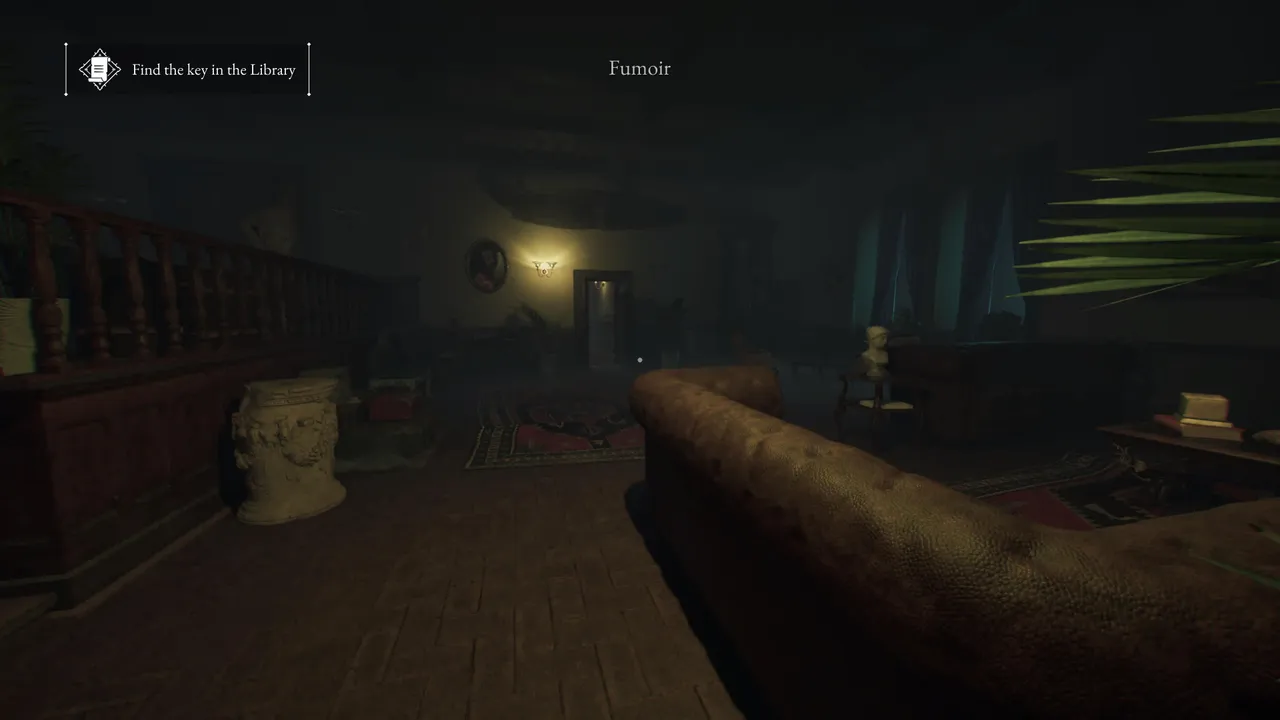
The Alighieri villa is mostly covered in brown, shady, and muddy tones, with a lot of gloom and shadows everywhere you look. It appears as a place where either something bad happened, or where a lot of sadness lives, but it still looks like a posh, old-money kind of place.
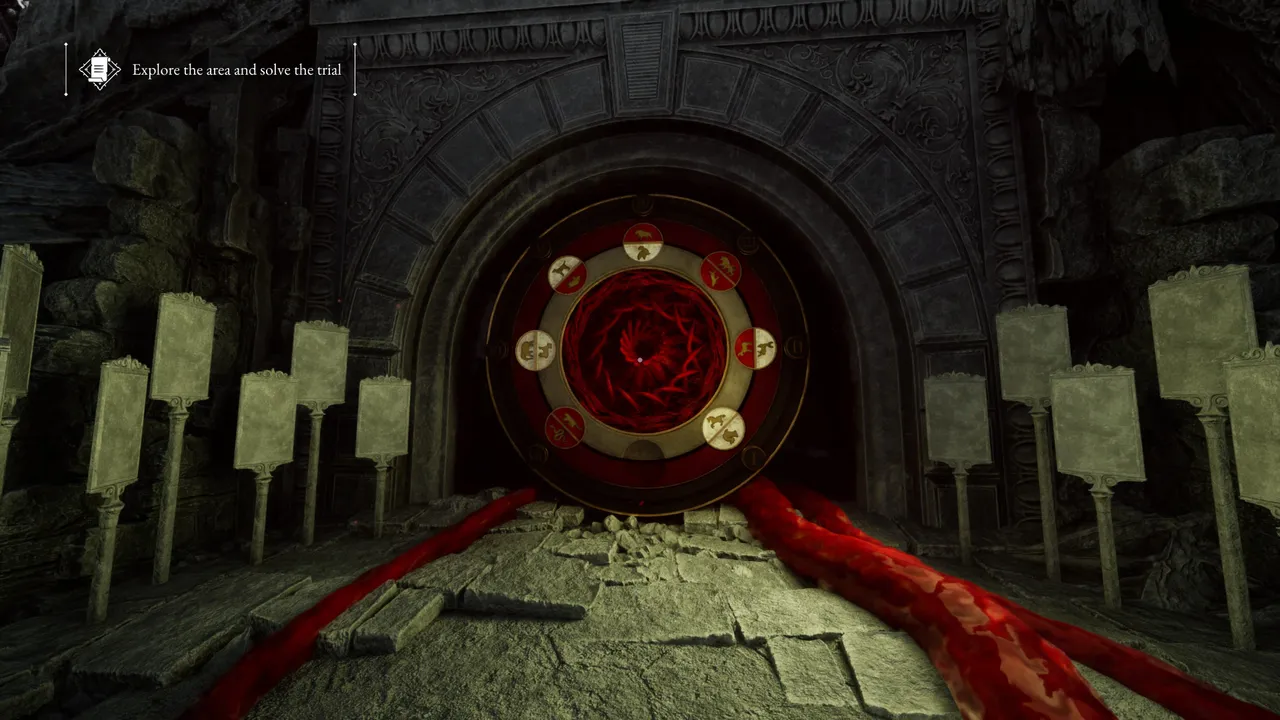
The Dive, or Hell, looks completely different. It's chaos, but controlled chaos, with seas of crimson and red taking over, and the representation of horror being abstract and playing nicely into the environmental storytelling. You'll see pools of blood, distorted objects, and misery everywhere around you. Hell gives you the feeling that maybe you shouldn't be there, but at the same time you have to go through it, and the atmosphere and presentation all fit nicely into the idea of a place where darkness and fears are built. As it lacks any real jump scares, the way the game shows hell is what brings the sense of terror. The atmosphere is spot on, and the sense of isolation and pressure slowly builds up everywhere around you.
The representations of these two environments are one of the strongest aspects of the game.
The voice acting is nicely done, as are the interactions between the characters. I especially liked the ancestor and his voice actor, as listening to him felt like hearing a higher voice speaking from above. You won't encounter much music, mostly ambient sounds, especially when you're in Hell.
On the technical side, I did encounter some minor frame drops, as well as textures seeming a bit off from a distance and looking a bit blurry. Usually, I wouldn't mind these all that much but considering the fact that this is a walking simulator, I'd like to have nice things to look at.
A circle not quite closed
Going in as a Dante fan, I knew this game would have a lot to live up to, and in some ways, it did. The environments and puzzles are the stars of the show, and the representation of Hell is where the most love and care has been poured in from the developers. The trials show what the game is capable of doing. I just wish there was more to it, more puzzles, more story, a bigger game with more material to dig into.
I don't really mind shorter games, but when the best parts of the experience are the trials, you can't help but wish there were more to them, and more to the Hell you're exploring.
The worries that I had when I started this game didn't go away, but they also didn't turn out the way I thought they would. This isn't a bad game; it's a solid idea and a good foundation, but it stopped too soon and never got the chance to grow into something much bigger and more memorable.
As a Dante fan, I was expecting to go through his circles of Hell and get the full experience; instead, I only got three circles, a lot of walking and a little bit of story, which is a shame, as I know the potential of this game is much, much bigger.
The Good
 The core trials are logical and well-designed
- A strong atmosphere of isolation and dread
- Hell's abstract presentation fits the storytelling perfectly
- Good voice acting
- Rewarding collectibles
The Bad
 Short runtime, with only three circles of Hell explored
- Map can be confusing
- Repetitive gameplay loop
- Blurry distant textures, minor frame drops