Trending
Even though I grew up at a time when cartoons like Dragon Ball were all the rage, I was never into them. I remember being one of the few, because my friends couldn't shut up about them, and I kept asking myself, 'What in the world do they see in those cartoons?'
And since I wasn't into Dragon Ball, which was hugely popular in the part of the world where I was born, it is hardly surprising that I only heard of One Piece a few years ago, when I was offered the chance to review One Piece Odyssey. I turned it down, specifically because I didn't know the first thing about its characters, lore or anything else tied to it.
All this brings me to One Piece: Grand Gourmet, a game set in that very same, enormous universe. I'm not quite sure it should have been my entry point, but it is what it is.
Story – A Kitchen on the Waves
I have already taken a huge weight off my chest by admitting I know nothing about One Piece, but luckily, as far as I can tell, this game isn't part of some grand story unfolding in that universe. To be completely honest, One Piece: Grand Gourmet barely has a story at all; it exists only to give you an excuse to cook. There is a band of pirates called the Straw Hats, led by a rubber-limbed, permanently hungry captain named Luffy, and among them sails Sanji, the crew's cook.
Sanji apparently once worked at a floating restaurant called the Baratie, and Grand Gourmet hands him a sequel of sorts, Baratie Number Two. You play an amateur chef working alongside him and the rest of the crew, and your task is to turn a modest ship into the greatest floating restaurant the seas have ever seen, all while sticking to one house rule: no customer gets turned away.
That is about as deep as the plot goes. There is no grand adventure and no villain to chase, just a steady stream of visitors from across the One Piece world, with more than 400 characters popping up as customers and staff. For a fan, I imagine this is a parade of familiar faces. For me, it was a parade of colourful strangers with names I had to look up, and dishes like Sea King Penne Gorgonzola or recipes built around Devil Fruits (magical fruits that grant superpowers, as I learned) sailed straight over my head. Still, the premise itself is simple enough to follow, and if anything, Grand Gourmet works as a low-pressure introduction to a universe I had been ignoring for years.
Gameplay – Order Up
If you have ever wished a game would guide you through every single step, Grand Gourmet will grant that wish and then some, to the point where you'll ask yourself, 'Is this really necessary? Does the game think I'm stupid or something?' A huge chunk of the opening hours is spent with the game telling you to press this button and do that, with no real involvement on your part.
I swear to God, this lasted for the first two hours or so, and it bored me to the bone. The next thing I found quite frustrating is the way the game handles text. Every conversation and every piece of information in Grand Gourmet is written on screen, with no voice acting at all, and that is completely fine; no complaints there. What did bother me was how quickly those walls of text disappeared. In games like this, you usually click once you have read a line to move on to the next one. Here, no matter how long the text is, it stays on screen for exactly the same amount of time, and that time is really short. Because of that, I missed half of the conversations, and as a newcomer to the universe, I felt totally lost. And before you ask, no, there is no option to change it.
Now, with that off my back, let's see what Grand Gourmet actually does well, starting with the gameplay loop, which, I must confess, can be quite addictive. Your base of operations is a small pirate ship turned into a floating restaurant, which you can modify as you see fit. From the very first moment, customers start coming in for meals; you serve them, and if they like what they eat, your reputation grows. Customers bring money, money goes into new recipes and customisation items, and that is how your business grows.
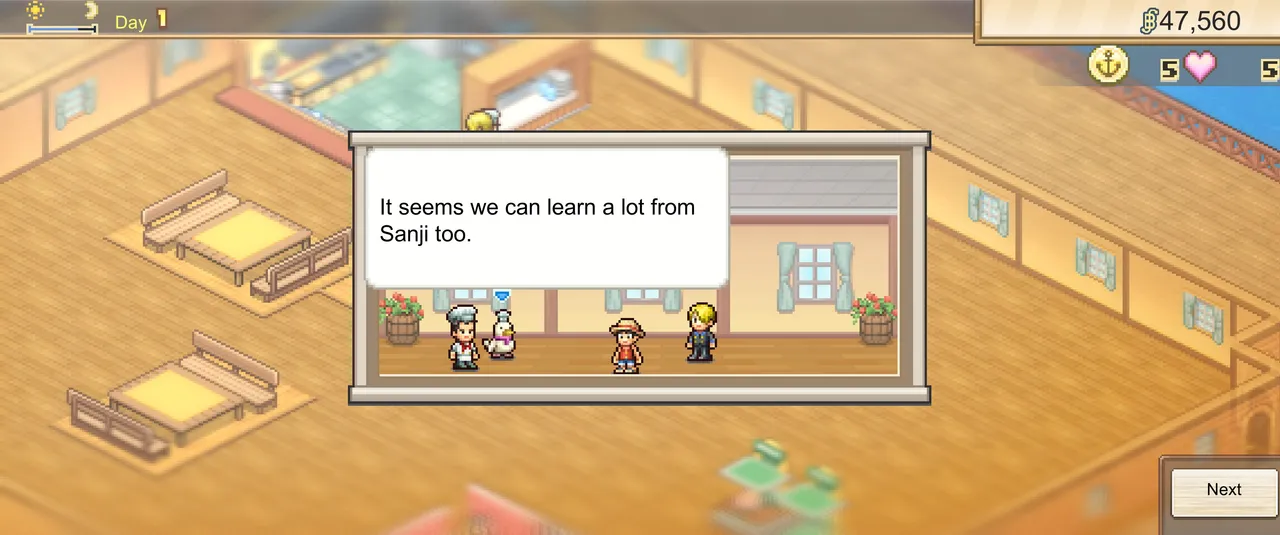
Grand Gourmet is all about cooking, and cooking is where it shines brightest. Characters visit your restaurant, and if they feel comfortable, they will often drop ideas for new recipes. Those ideas turn into meals with some of your own special touches, and that is how you win new customers and keep the existing ones coming back. It is worth noting that you don't actually cook anything; that is Sanji's job. Yours is to please customers and make decisions, without mini-games or stressing about how a meal will turn out.
One small detail I liked very much (and which probably has some background in One Piece lore) is that customers with Devil Fruit powers can help you in the kitchen, zapping a dish with lightning or setting it on fire. I tried to dig into who these characters are and where their powers come from, but the One Piece universe is so vast that I quickly got lost. In any case, Devil Fruit powers were a joy to play around with, and any meal involving them was a hell of a lot of fun to make.
I mentioned different recipes earlier, and each one requires different ingredients, which can be found in different places. That leads us to exploration. You can leave your ship to gather ingredients, which breaks up the monotony of running the restaurant day after day.
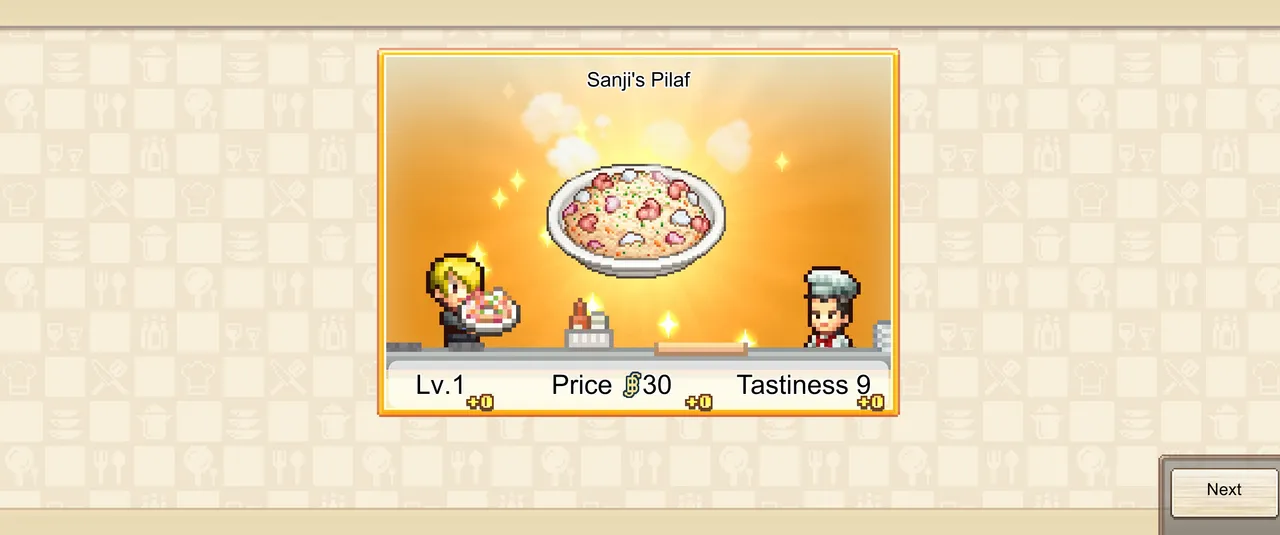
And then there is the decorating, which, in my opinion, is the second-best thing Grand Gourmet has to offer, after cooking, of course. More than 200 pieces of furniture, building parts and decorations let you shape the restaurant to your liking, with various One Piece themes that, to be honest, meant nothing to me, though I'm sure hardcore fans will appreciate them.
Decorating plays a much bigger role than mere cosmetics, as each customer has their own tastes, and if a character likes what you have done with the place, they may become a regular. Characters can also work as your staff, and their interactions unlock special events along the way. This can be quite engaging up to a point, but with so many characters, each with different tastes and abilities, assigning roles can get rather complicated, and what was supposed to be a feature can quickly turn into a nuisance.
Visuals and Sounds – Lost in the Beige
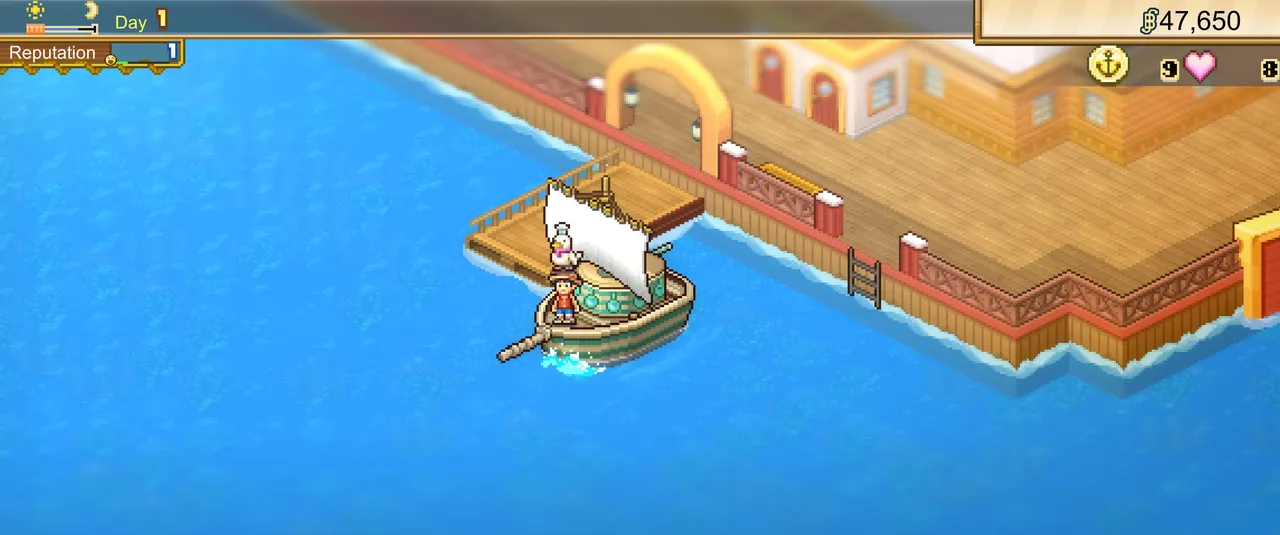
Grand Gourmet marks the first time One Piece characters appear in Kairosoft's pixel-art style, and I have to be very honest here: this might be the least attractive pixel art I have ever come across. The restaurant interiors look very monotone, coloured in the same shades of beige. Everything inside the restaurant (furniture, floors and even the posters you can unlock to decorate its walls) looks very similar and blends together. On top of that, the strange blur around the edges of the screen only makes it harder to tell what is what.
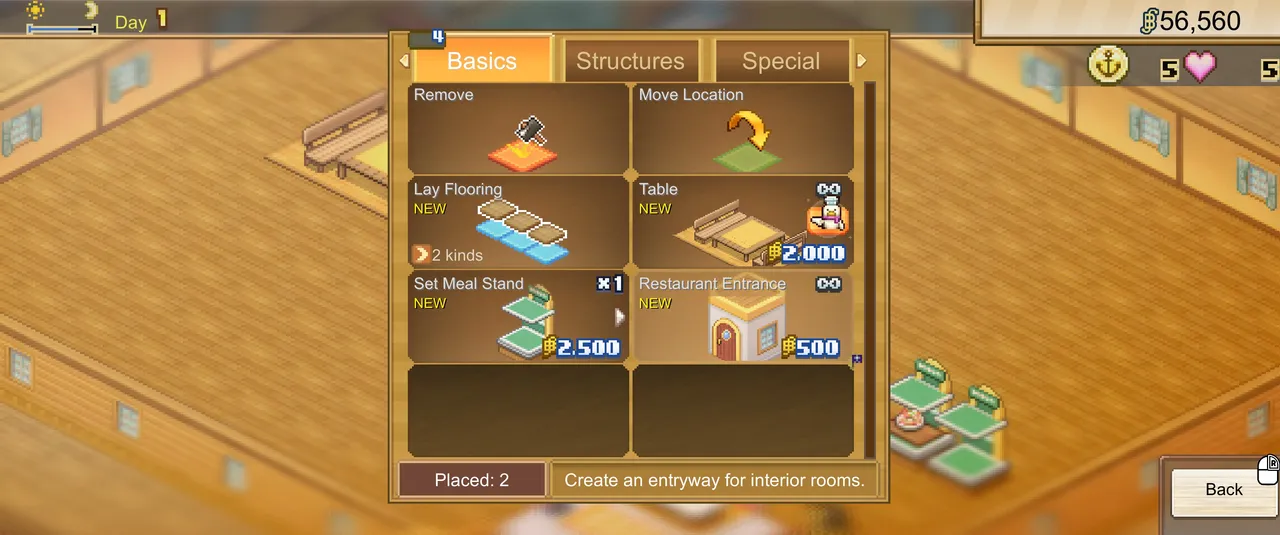
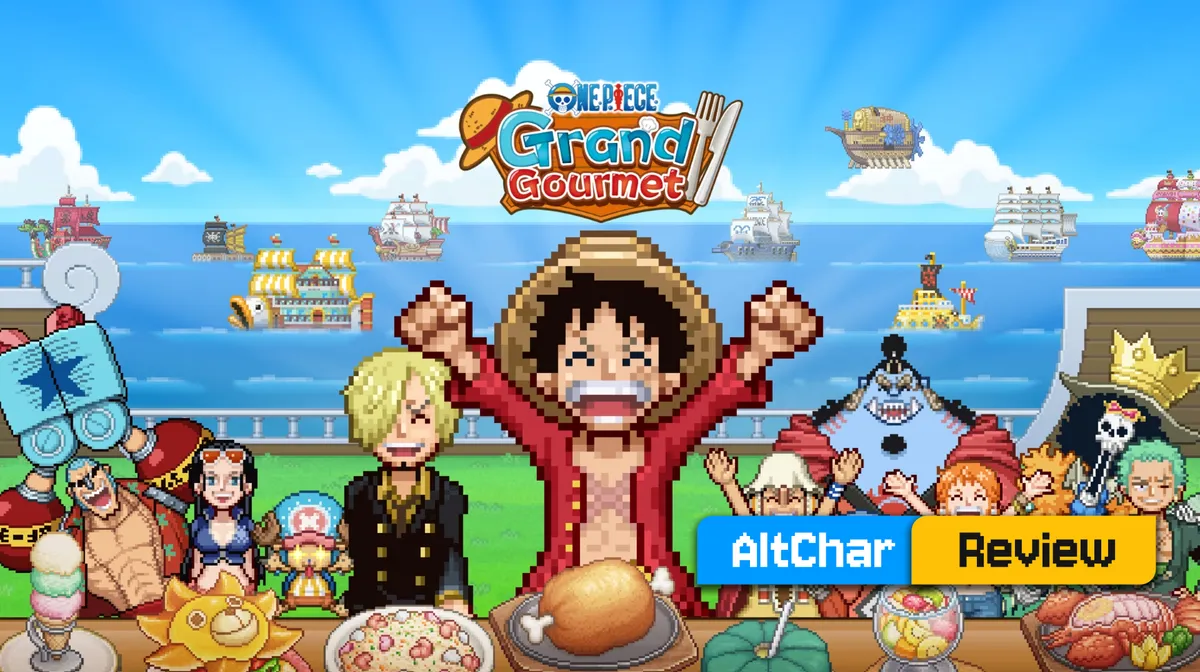
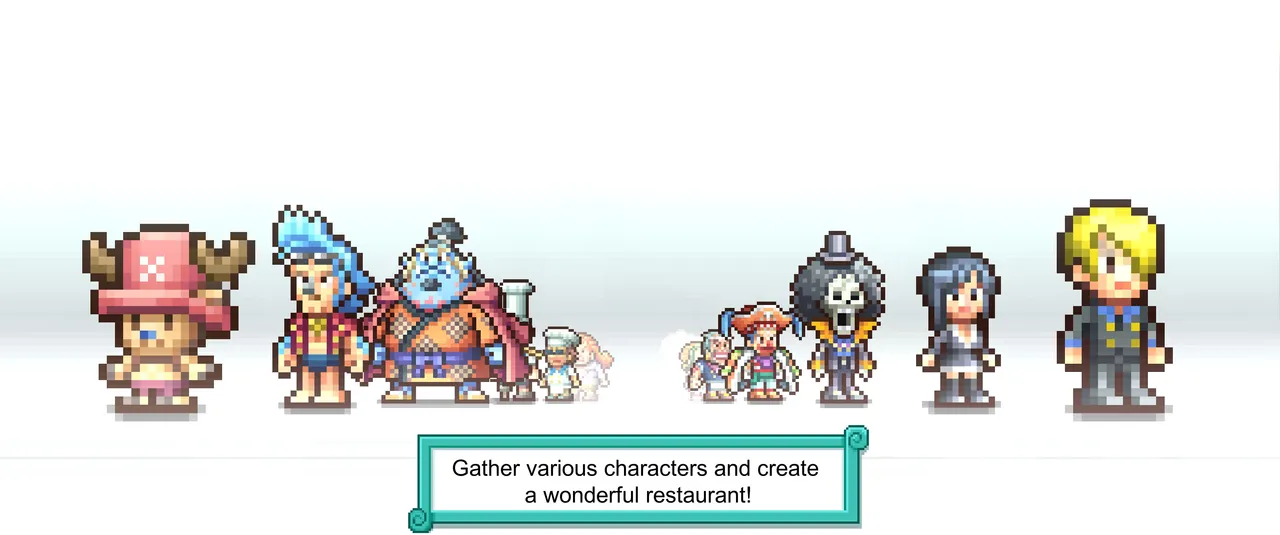
Small character models suffer the most, as they are so tiny and so short on detail that you can barely make out a face, while the larger versions used in dialogue scenes look crude and blocky. And then there is the ocean, which looks like a huge blue rag thrown across the screen, lacking the proper waves we have seen in so many gorgeous pixel-art games. I also remember Grand Gourmet's promotional art looking sharper and more colourful, and definitely nothing like what I actually experienced.
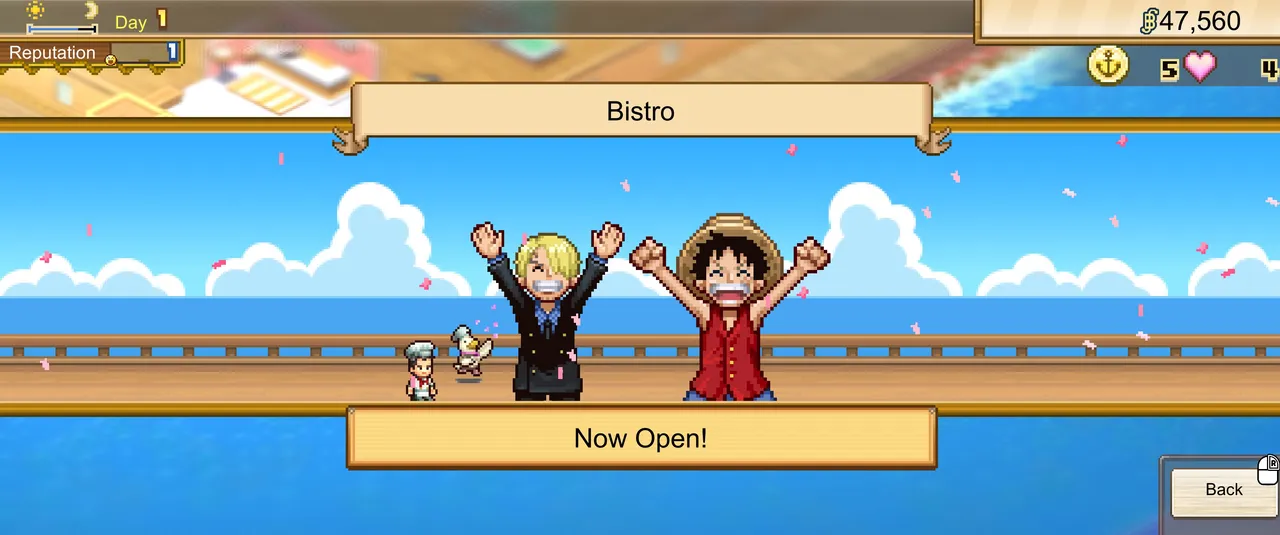
Of course, the visual presentation is not all bad. The sheer volume of content is impressive, with more than 400 characters and over 200 pieces of furniture and decorations, and the themed sets at least give you room to break up the monotony as the restaurant grows. The food illustrations that pop up whenever you create a new dish are among the better-looking moments, with a bit more colour and detail than anything else on screen, and the celebratory scenes, such as the one marking the restaurant's grand opening, have a cheerful energy.
The interface is also clean and readable, which matters in a management game where you spend most of your time in menus. Still, none of this changes the fact that, for the most part, Grand Gourmet is simply not pleasant to look at.
As for the sound, there really isn't much to say. The music, mixed with the ambient sounds of the open sea (seagulls, creaking ships, waves and all that), does exactly what it sets out to do: relax you, because One Piece: Grand Gourmet is, above all, a relaxing, stress-free game. Some background tracks can become repetitive, especially since each part of the game, from restaurant management to the menus, has its own song, so if you spend too long in one place, the music can grow tiresome and, at times, even tedious.
Conclusion
One Piece: Grand Gourmet was my first proper step into the One Piece universe, and I can't say it made me want to rush off and play every piece of One Piece out there. Still, beneath the hand-holding and the text that vanishes before you can read it, there is a cooking and management loop that is easy to sink hours into, and the Devil Fruit-powered recipes and huge pile of decorating options give it more personality than I expected.
Unfortunately, that loop is easily overshadowed by a slow, overly guided start, a sheer number of characters that becomes harder to manage the bigger it gets, and visuals that are hard to look at for long stretches. Fans of the series and of Kairosoft's management games will likely find enough here to justify the $19.99 price tag, but as a newcomer, I mostly felt like a guest who wandered into the wrong restaurant.
The Good
 Addictive gameplay loop
- Devil Fruit-powered cooking
- Huge character roster
- Over 200 decoration items
- Exploration breaks the routine
- Relaxing soundscape
The Bad
 Overlong hand-holding tutorial
- Dialogue text disappears too quickly
- Bland, washed-out pixel art
- Messy staff management
- Repetitive music