Trending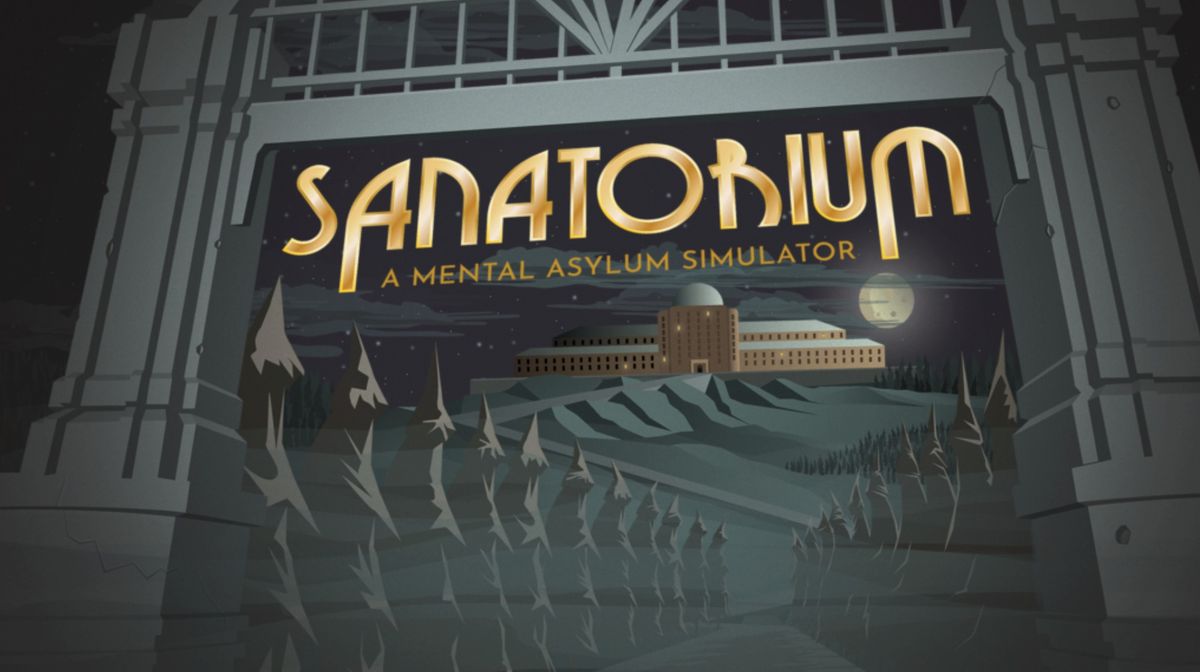
Developed by Zeitglas, a four-person studio from Zürich and published by Shoreline Games, Sanatorium - A Mental Asylum Simulator is a card-based workplace sim where your choices matter.
Story
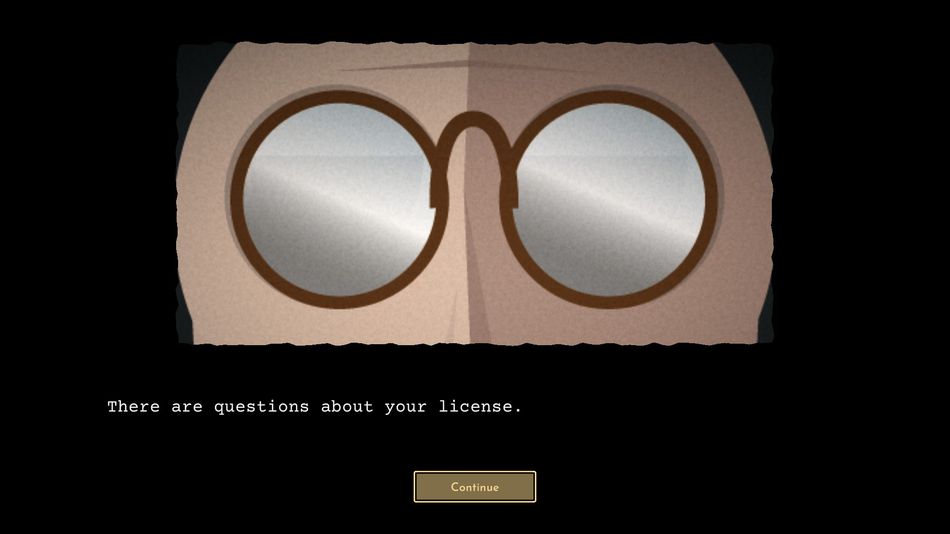
The year is 1923, and psychiatry sits somewhere between science, guesswork, and ‘’maybe a lobotomy will help.’’ Your journalistic career is struggling, but a personal mystery, and perhaps the promise of a breakthrough story, leads you to become an undercover doctor at Castle Woods Sanatorium. Your mission is to fake competence well enough to treat patients, uncover the institution’s secrets, and avoid being exposed by your supervisors and handed over to the police.
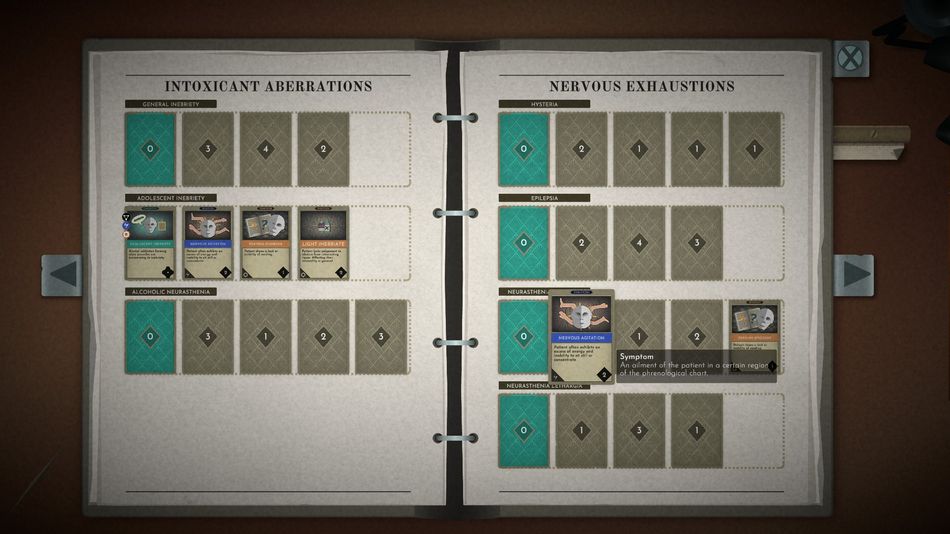
What struck me first was the paperwork - patient files neatly laid out, symptoms and syndromes waiting to be analysed, and tests and treatments applied with all the expertise and confidence of someone with no medical qualifications.
Visuals
Sanatorium has some really nice visuals without being too loud about it. The Art Déco style wrapped in a palette of muted greys, faded beiges and sickly blues, all complemented by the subtle sound effects and small, deliberate touches: the scratch of a pen, the rustle of files, cups and plates abandoned outside patient rooms, cracked paint, tidy furniture. Everything feels carefully crafted, and it just clicks.
Gameplay
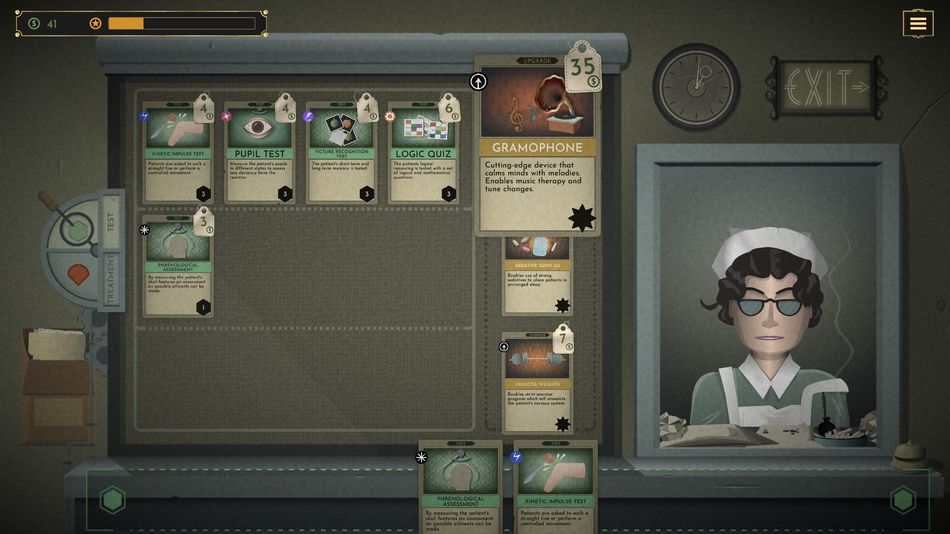
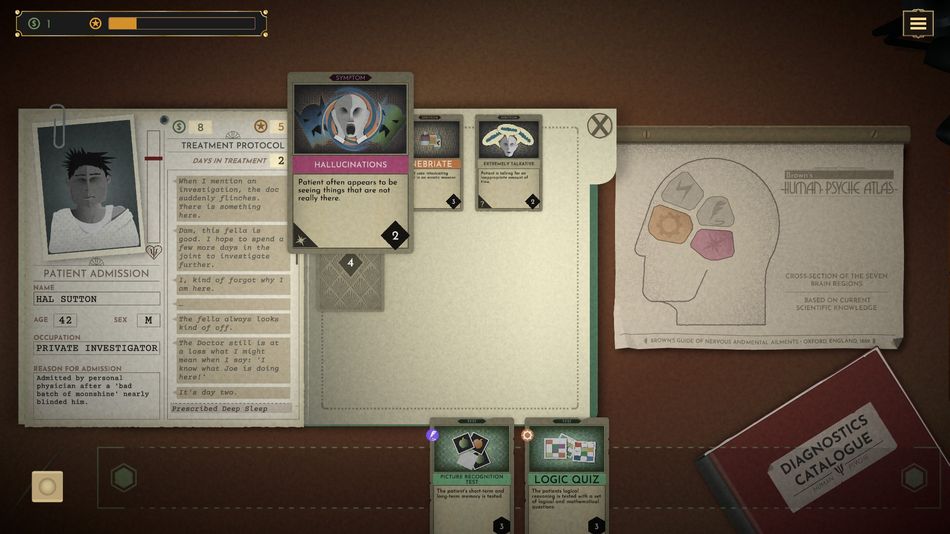
Each day begins with deckbuilding at the ward station. You assemble test cards that will help you examine the patient, like logic quizzes and pupil tests, alongside treatment cards you’ll apply at the end of the day. The ward station also hints at which brain regions - impetus, memoria, mania, and so on - will dominate the day’s cases so you can prepare accordingly. Similarly, cards are tagged accordingly and must be purchased with whatever money you’ve managed to scrape together.
Patients' files arrive with symptom cards, some known up front, others concealed until you pry them open with the appropriate tests. These symptoms can be dragged onto patient portraits to interrogate them further and uncover fragments of patients’ personal history in the process. To properly administer treatment at the end of the day, all known symptoms need to be categorised by brain region during your session, so it’s a satisfying loop of organisation, deduction and judgment. And if you’re not already in the field, you might accidentally learn a thing or two.
Now treatment is where it gets fun and…morally flexible. The game never forces you to be cruel, but, at times, it definitely makes it easy. Keeping rich patients in treatment longer than necessary just to increase your earnings? Sounds convenient. A ‘’misbehaving’’ patient? Maybe a surprise bath or restriction therapy will do. Every patient requires a minimum daily intervention, but what that looks like is entirely up to you.
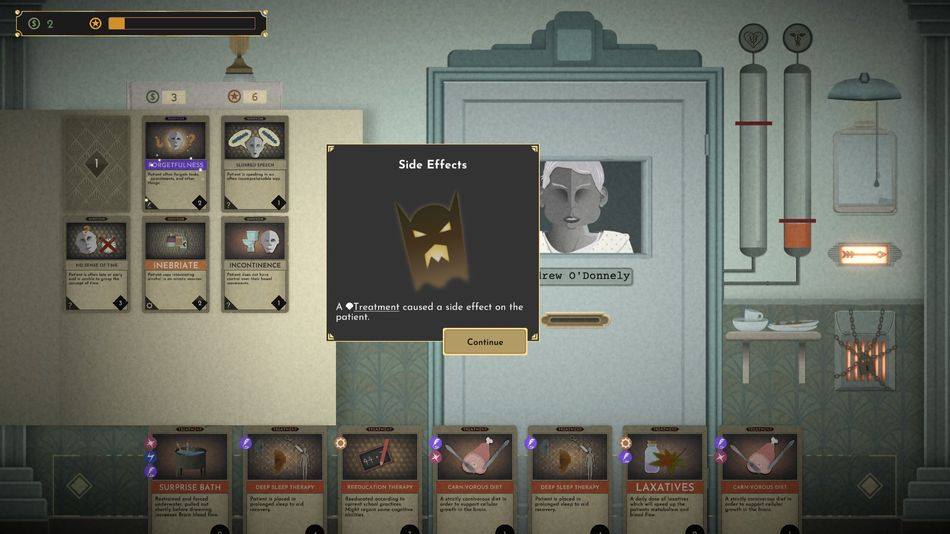
However, you will need to balance income and prestige. Successful treatment and correct diagnoses earn you prestige, but prolonged patient stays earn money. Before long, you may stop asking what’s best for the patient and start calculating what’s best for yourself.
The moment I knew the game had me was its signature mechanic: after every treatment, you must literally drag a pen across the screen to authorise it. It’s such a small touch, yet absurdly satisfying - I found myself looking forward to it like a tiny dopamine button, and it reinforces the performance, making you feel, however briefly, like you actually know what you’re doing.
Conclusion
The preview cuts off after roughly two hours, so when I eventually reached that point, I was disappointed in the most positive way - I wanted back in. The developers confirmed multiple story endings for the full release, and I’m curious to see just how far the role-playing can go when I’m not constrained by time.
All in all, Sanatorium - A Mental Asylum Simulator presents a compelling concept with some neat mechanics. Depending on how you play, it can be serious, methodical, or even unintentionally funny.
One thing I know for certain is that I’ll be back on release to see how the full experience unfolds.