Trending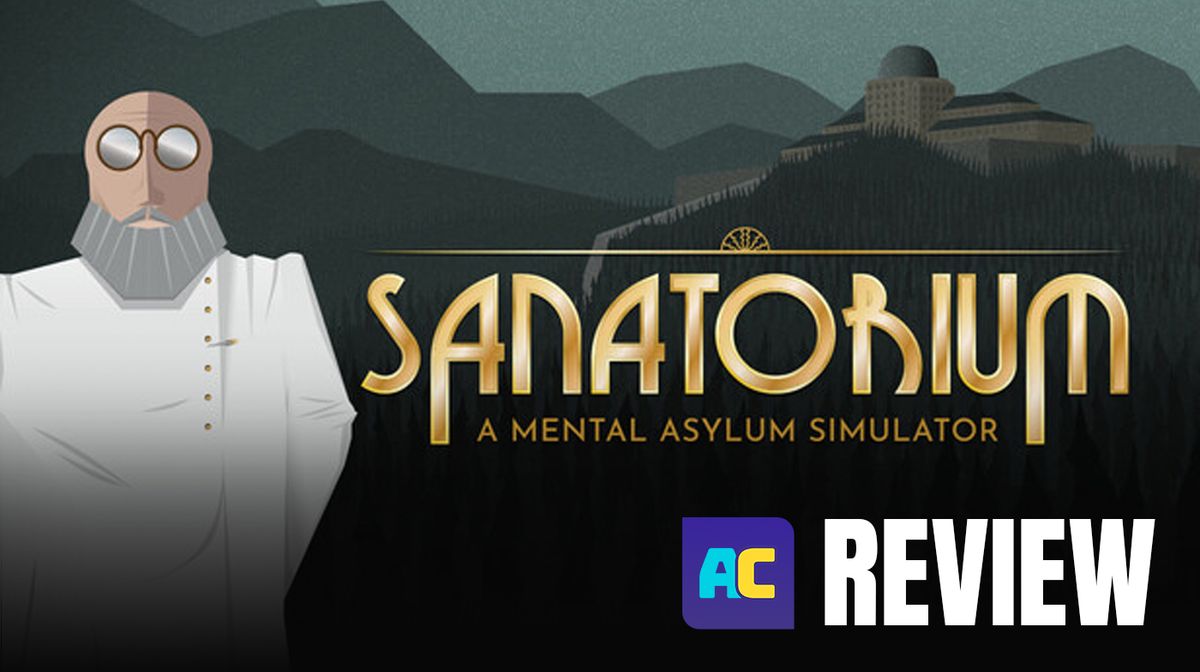
Sanatorium is a card-based management sim from Zeitglas, a four-person indie studio based in Zürich, and you can feel that small team size throughout the experience.
While Sanatorium’s foundation is solid, it stumbles on technical execution. When it’s working, though, it understands just how engaging paperwork can be.
STORY & PRESENTATION
It's 1923, and psychiatry is still throwing experimental treatments at the wall to see what sticks. You're a journalism graduate with zero prospects infiltrating Castle Woods Sanatorium as a fake doctor to investigate your aunt Patricia Boyd's suspicious institutionalisation in Ward 4. Dr. Bertham runs the place with iron authority, while station nurse Margaret Harrington chain-smokes through her shifts (gotta love the 20s) and probably knows more than she lets on.
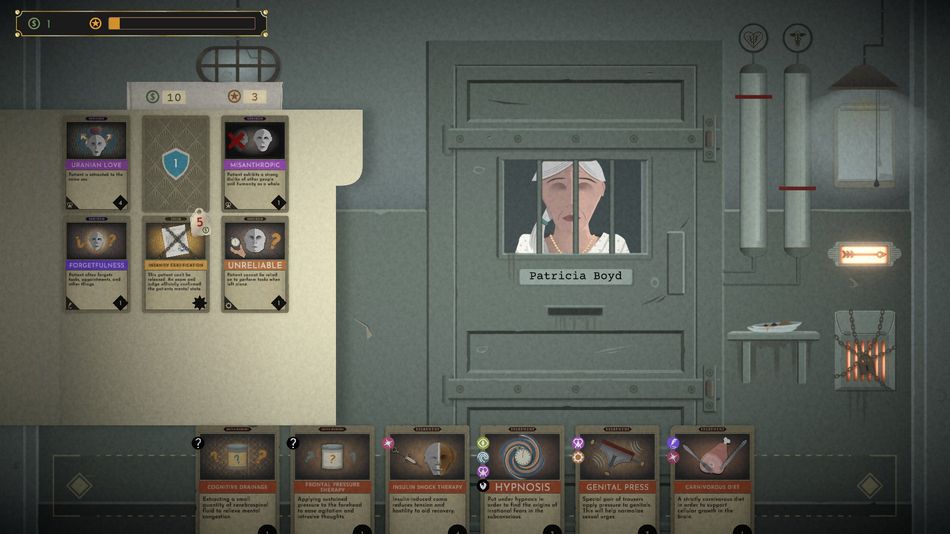
Patients quickly become recognisable faces: the Brewer sisters Clara and Fiona, Hal Sutton, Jacob van der Helde, Andrew O'Donnell, multiple shell-shocked war veterans, and other individuals, some of whom will open up during sessions and perhaps drop useful narrative hints.
Turns out it’s not only you who’s undercover, there’s other ‘patients’ investigating Castle Woods’ shady dealings, adding another conspiracy layer to the investigation and late-game choices. Some patients remain closed off entirely, while others make you question whether they belong there at all.
Sanatorium’s story progression is structured across four wards, each unlocking as you’re getting more proficient at patient treatment and uncovering Castle Woods' secrets. Ward 1 eases you into diagnosis and treatment basics, while Ward 2 deals with nervous illnesses and psychological trauma and also introduces a ‘subplot’ - someone gets murdered, hanged precisely, but the whole affair gets swept under the rug to avoid scandal and hide whatever else is happening behind these institutional walls. Then there’s Ward 3, which keeps the ‘asocials’ and introduces experimental treatments that expand your toolkit. Finally, Ward 4 houses the criminally insane, including your aunt Patricia, presumably.
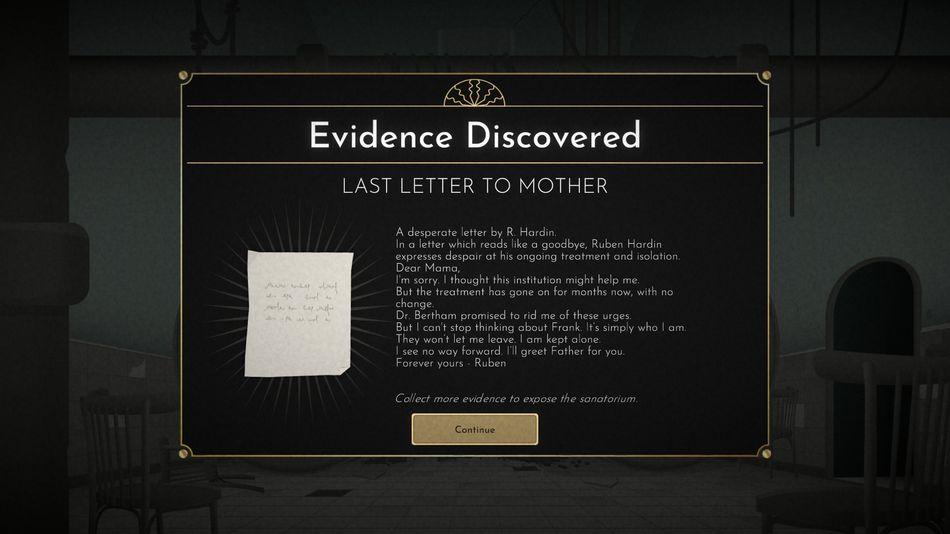
As you’re progressing through the story, you're also collecting evidence - letters, confidential documents, whatever scraps you can find - by exploring restricted areas after your daily treatment sessions. The investigation thread is light, but it weaves nicely through the management gameplay without feeling forced, which creates a nice balance between being a somehow competent doctor and an investigative journalist with a personal goal.
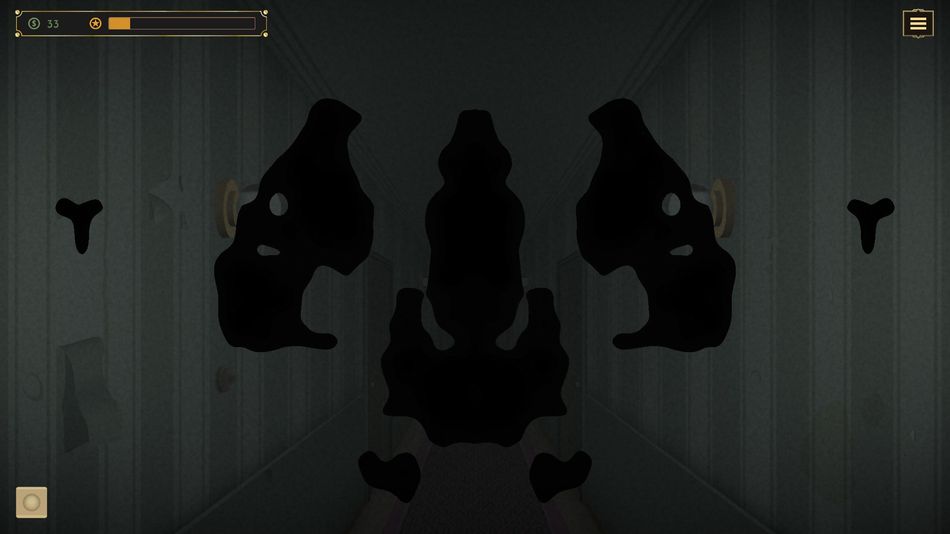
Overall, Sanatorium’s presentation is really nice. The Art Déco style nicely captures the essence of the 1920s, Rorschach inkblot scene transitions feel thematically fitting, and the audio - typewriter sounds (which you can disable if they drive you mad), treatment card effects, and the almost funky jazz music – prevent things from becoming too oppressively dark.
You can also switch out vinyl records and change the tunes on the gramophone, a neat little detail that really makes a difference when you’re stuck in that office for hours on end (literally). Even the period-relevant terminology, like ‘’shell shock’’ instead of the more contemporary term ‘’PTSD’’, adds to the feeling that Castle Woods could have existed a hundred years back.
CORE GAMEPLAY
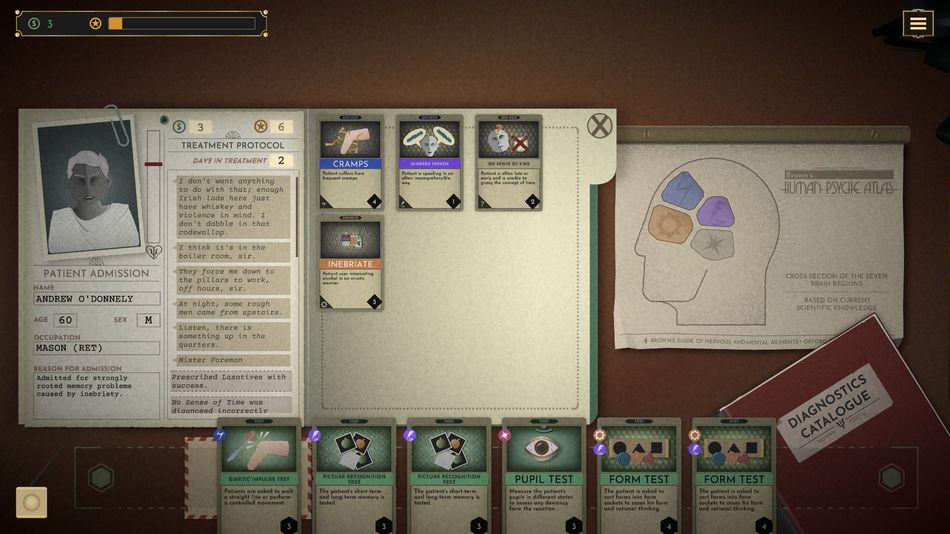
Campaign mode delivers the story experience, while Endless mode tests how long you can maintain the charade before exposure forces a game over. Each day begins with deck building at the ward station, where you buy a limited amount of test and treatment cards. Test cards help reveal patients’ hidden symptoms during your office sessions, while treatment cards actually address them once your office one-on-ones are over. The station also shows which brain regions you'll handle that day: impetus, memoria, mania, and several others that unlock as you progress, so you can effectively prepare for each day.
Patient files arrive one by one. Some symptoms are visible immediately, others hide behind numbered counters, requiring the above-mentioned test cards to reveal them. There are other suppressed, so-called catalyst symptoms that can be opened with revealing treatments only, but the essence is the same.
Running tests drops the numbers on symptom cards before they eventually surface. You can drag these symptom cards onto patient portraits, and sometimes they'll share more about their families, what brought them to Castle Woods, and whether they actually belong here at all.
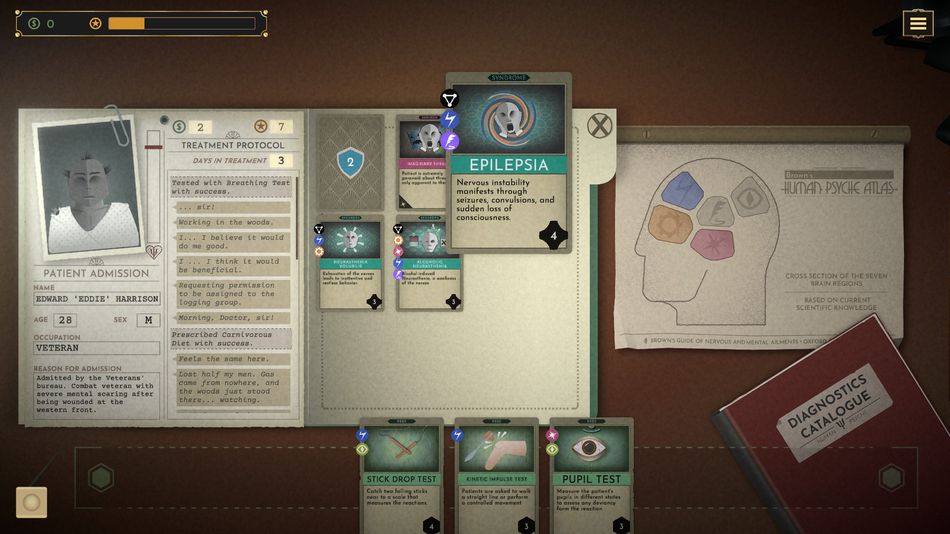
The core loop involves sorting newly discovered symptoms by brain regions. When enough symptoms are combined, they form a syndrome, which can be treated as a single condition. Place that syndrome card down, or rather select it from the diagnostics catalogue, and it clears the individual symptoms in one satisfying motion. It feels like you're organising a chaotically messy drawer, except the drawer is someone's fractured psyche, and you don't really have a medical degree.
Since symptoms can overlap across different syndromes, you can identify several syndromes simultaneously. For example, nightmares are a symptom of both Hysteria Bellica and Neurosis Bellica. Which syndrome applies depends on the patient's other symptoms, but you can classify a syndrome even based on a single symptom card.
New brain regions and card options are introduced gradually, which nicely matches your character arc as a fraud learning on the job, making mistakes, and hoping no one notices. The progression system does not throw everything at you at once, so the increased complexity feels earned rather than overwhelming.
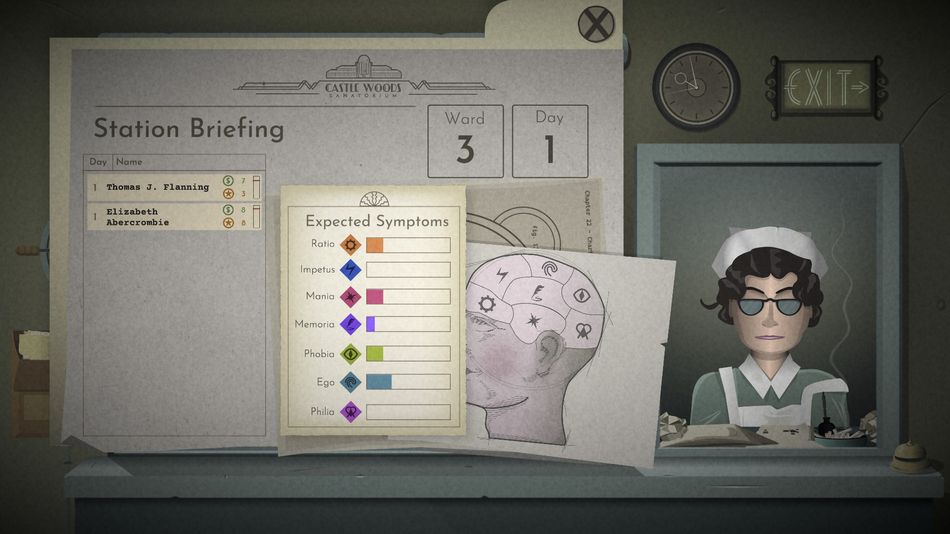
Every patient requires a minimum daily treatment threshold to maintain your professional reputation, but how you reach that threshold becomes an interesting moral calculation. Say there’s an upgrade you need to help reduce treatment side effects. Conveniently, there might be a wealthy patient requiring additional days of care. This is also where Sanatorium’s cash vs prestige balancing tension becomes the central management aspect of the game. Cure people efficiently, and your prestige rises, but keeping patients hospitalised generates money, letting you buy better cards and upgrades. Along the way you stop thinking about what helps your patients and start calculating what helps you survive another week.
The game deliberately puts you in this morally questionable position, then steps back to watch how you handle it. There's no morality metre turning red to punish you, just the numbers tracking days hospitalised. Instead, it gives you the tools to rationalise anything, enough for you to start thinking like an administrator instead of a carer, which is precisely the institutional mindset that allowed places like Castle Woods to exist.
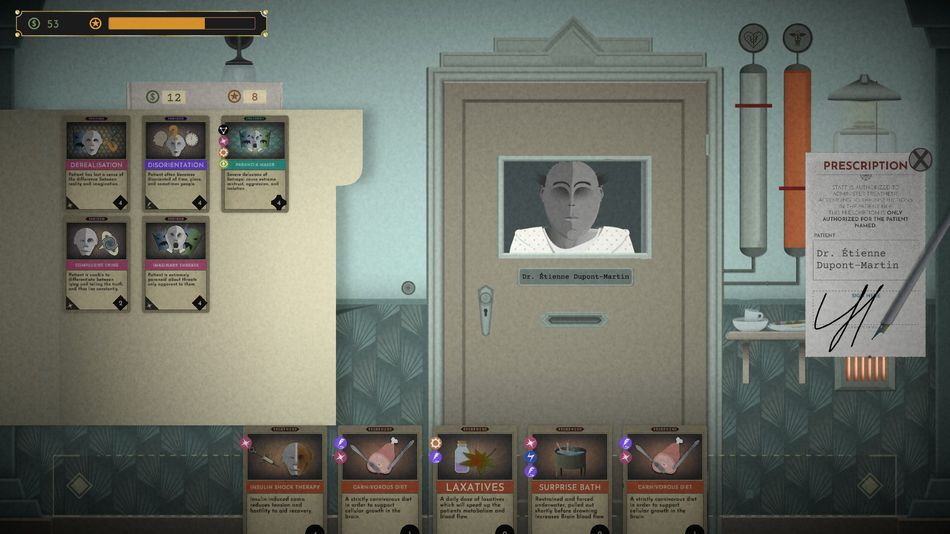
After every patient treatment session, you drag your mouse across a small piece of paper on the screen to physically sign the prescription waiver, and it's stupidly satisfying from a tactile feedback perspective. I genuinely looked forward to it every single time, this brief moment of fake authority where you commit to the lie in wet ink. Leave your cursor sitting stationary too long, and the ink realistically drips onto the paper below. I completely missed this detail in the preview build. It doesn't affect gameplay whatsoever, but it matters completely for the atmospheric feel. For a brief second you feel competent and authoritative, like you actually know what you're doing medically.
QUALITY OF LIFE AND BALANCE ISSUES
Ward 3 introduces experimental treatments that expand your toolkit, along with a backdoor shop system where you can upgrade cards left over from that day. But here is also precisely where the game's mechanical issues become impossible to ignore.
Treating patients properly becomes a bit more difficult as systems grow more complex. I literally had to scribble my own reference notes on physical paper to track treatments effectively. As diagnostic complexity ramped up, I desperately wanted UI options to minimise the diagnosis catalogue, to be able to select syndromes without memorising which symptoms patients had and then turning the catalogue pages on a full screen.
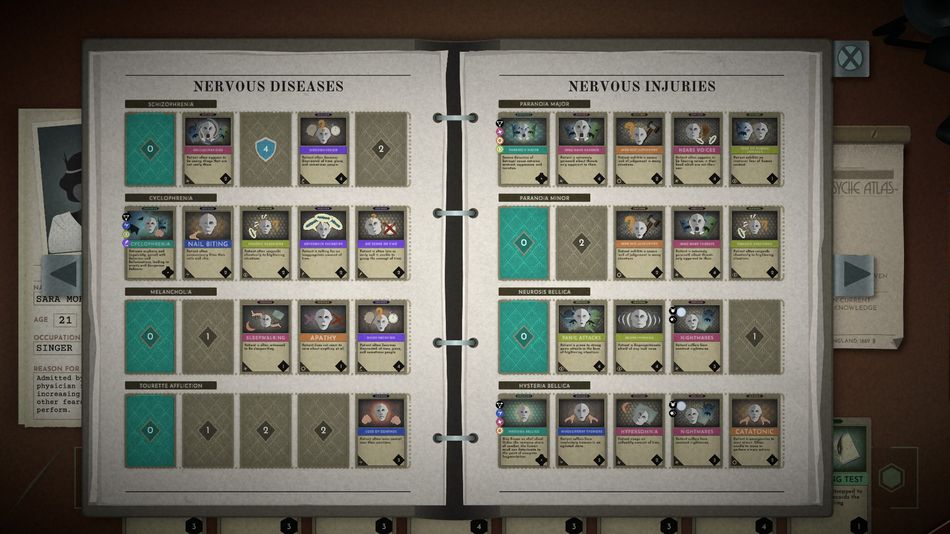
Several smaller problems compound frustratingly: syndrome cards don't automatically merge when you have two identical copies, unnecessarily cluttering your limited workspace. You can't skip or speed up patient monologues, which becomes tedious on replay attempts. The punishment system for getting treatment wrong sometimes feels excessively harsh, as if the game's designed to waste your time rather than respect it as a limited resource.
After failing a day and reloading your latest save, the game starts you in the office instead of the ward station. This disrupts flow and forces you to restart the ward entirely if your remaining cards and prestige won't carry you through. These aren't bugs, but rather quality-of-life improvements that would significantly smooth the experience.
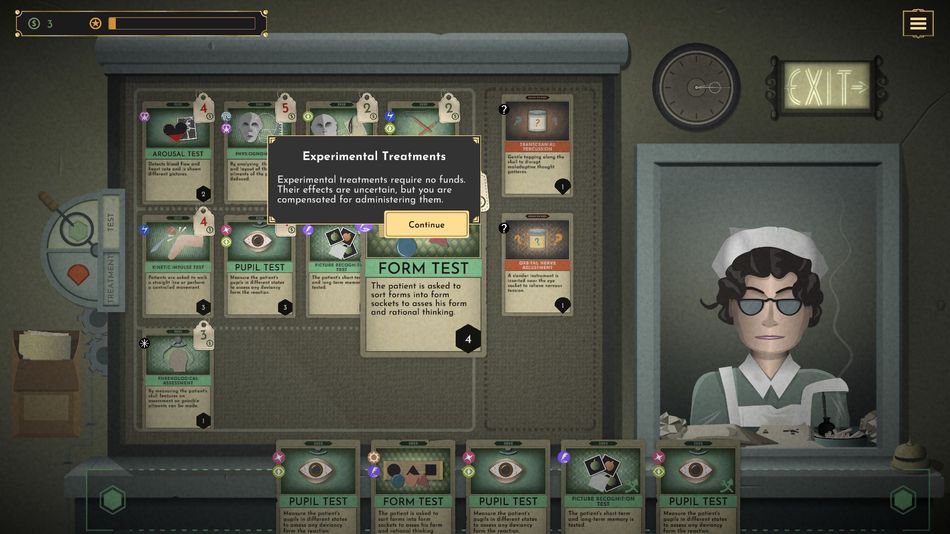
My experience in Ward 3 is that money completely stops being a strategic concern once experimental treatments are introduced. By Ward 3, I was earning three times what I could spend. Experimental treatments are free, which makes sense - you don't know what they'll target, and they still occupy valuable deck space - but there's an imbalance in currency management between Wards 1-2 and Wards 3-4. Early game, you're desperately scraping by, making tough choices about which patients to prioritise. Late game, you're swimming in excess cash. The economic tension that made early decisions interesting evaporates entirely, and suddenly half the strategic depth disappears with it.
TECHNICAL ISSUES
Here's what affects this review most significantly: one playthrough should take 4-5 hours to complete. I have over 20 hours logged, mostly fighting bugs. The bugs don't just persist, they actively worsen as the game progresses versus the preview build where I encountered not a single bug. What started as really enjoyable became a frustrating chore as I spent more time reloading saves, speeding through categorisation and treatment almost by heart, and fighting interface problems than actually playing.
Continue buttons that don't work (roughly six to seven times out of ten). Card previews permanently stuck on screen requiring a full Steam restart to clear. Progression-blocking freezes in my first two hours with the game.
The worst crash occurred during what should have been a routine session. I finished treating six patients when three additional, unfamiliar patients suddenly appeared in my queue without warning. As there was no way for me to balance treatment and prestige here, I thought I’ll just restart the ward, not that big of a deal. The reality: I couldn't restart that specific ward because the game froze on the last patient, and I could not progress enough for the game to give me that 'restart ward' option after I'm thrown into Castle Woods myself. So basically I had to restart the Campaign completely.
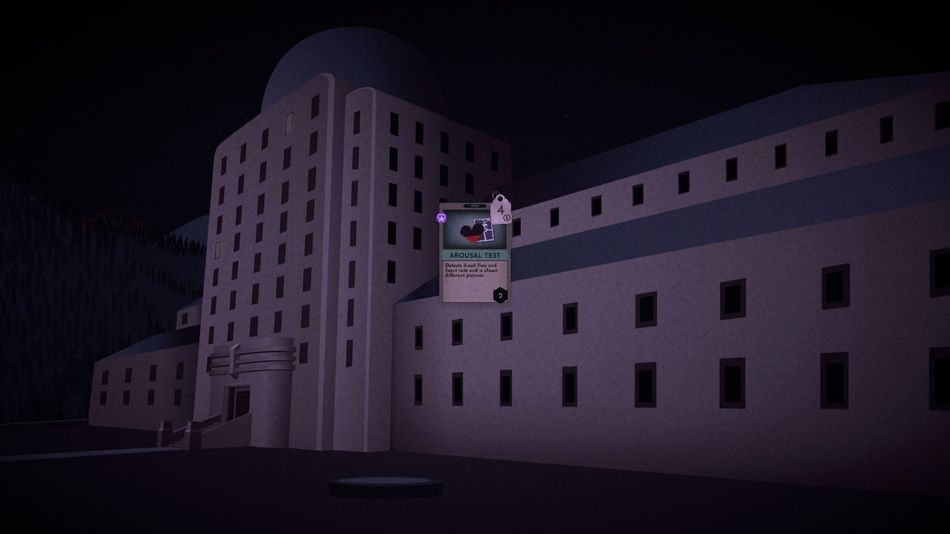
Experiencing progression-blocking bugs in about two hours is definitely rough, especially when you're invested in what's happening narratively. It pulls you completely out of immersion and breaks flow. You stop thinking about the conspiracy unfolding in Castle Woods and start anxiously thinking about when the next crash is coming and whether it's even worth continuing.
But if the bugs had stopped there, I might have found a way to justify it - like a parent insisting their child isn't a pyromaniac, they just burnt down three houses because they enjoy watching big fires. But the bugs persisted throughout. I somehow soldiered through it, split across three days versus what should have been roughly three hours.
I understand the reality here. Zeitglas is a small team working with limited resources. But this level of frustration is a significant problem that fundamentally affects whether I can recommend this game right now.
FINAL THOUGHTS
Sanatorium has an addictive flow. Its mechanics have considerably more strategic depth than they initially appear. The moral choices matter meaningfully, or at least feel like they matter, which is sometimes more important. That signature mechanic remains weirdly compelling even after you've performed it hundreds of times.
The branching outcomes and multiple endings (which depend on your investigation thoroughness and which patients you prioritise throughout the Campaign) suggest there's legitimate replay value, assuming you can actually reach those endings. I barely managed to get to one despite 20 hours of attempts, fighting through bugs the entire way.
Sanatorium isn't catastrophically bad. The core experience is solid and interesting when it works, but it's distracting and frustrating enough that I'd advise most people to wait before diving in. This could easily be an 85 or 90 once the bugs are fixed with patches.
Small note: I'm writing this four days ahead of the official release, but I don't have the energy anymore to load up a save and check if any bugs have been addressed.
Worth grabbing if you enjoy management sims with branching outcomes and moral complexity baked into mechanics, but definitely wait a patch or two if progression blockers will make you want to hurl your keyboard across the room. I was on the verge at least 16 times.
The Good
 Progression system that doesn't dump everything on you at once
- Makes paperwork engaging
- Moral choices that let you decide how terrible (or competent) you want to be
- That insanely addictive signature mechanic
- Nice Art Déco visuals
- Period detail that adds to the experience
- Interesting, branching narrative
The Bad
 Multiple progression blockers that force reloads and kill momentum
- Quality of life problems compound as complexity increases
- Economy balance breaks down completely after Ward 2
- Needs another stability pass before I can recommend it without reservations