Trending
Being a new instalment in a successful series like Monster Hunter carries a significant burden. The game not only needs to justify its AAA status and the substantial investment behind it but also has to uphold the legacy of its predecessors. No matter how good it is, it will inevitably be measured against games that hold legendary status among gamers.
I'm saying all this to set the stage for discussing the situation surrounding Monster Hunter Wilds. After all, whether you're a fan of this Capcom series or not, it's hard to call yourself a serious gamer without at least being aware of this franchise. While I've never been a huge fan of the series, I did dabble in some of the previous titles from time to time, and I have tremendous respect for these games.
Monster Hunter games are a different kind of breed among RPGs, and it is well-known. You can have only two feelings towards those games: you love them or you don't—there's no third option. The same really goes for the latest among them, Monster Hunter Wilds; if you're a fan of the series, you'll love it, but if these kinds of games do not sit well with you, it is highly likely that Monster Hunter Wilds won't click with you.
Story
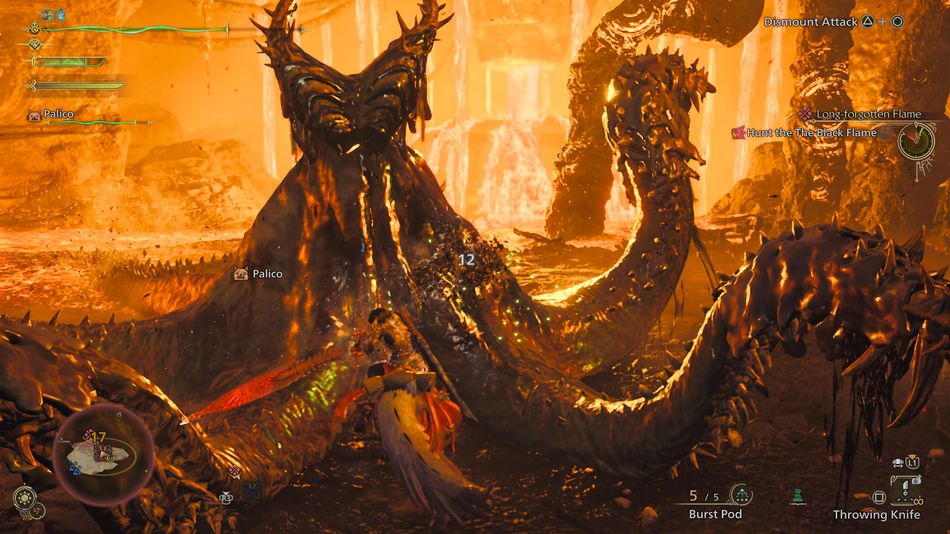
Let's just say at the very beginning: the story in Monster Hunter Wilds is as important as the traffic lights in GTA, and if you're a gamer, you'll understand the reference. Seriously, even though the story is present—I mean, every RPG has to have one, right—it's there only to justify your hunt on the creatures that will find themselves on your way all over Forbidden Lands.
Yes, this instalment takes place inside the mysterious and beautiful Forbidden Lands, in which the Guild thought there was no human life, so they're sent on the expedition to investigate the strange behaviour of the monsters, but their investigation will lead them to some unexpected discoveries.
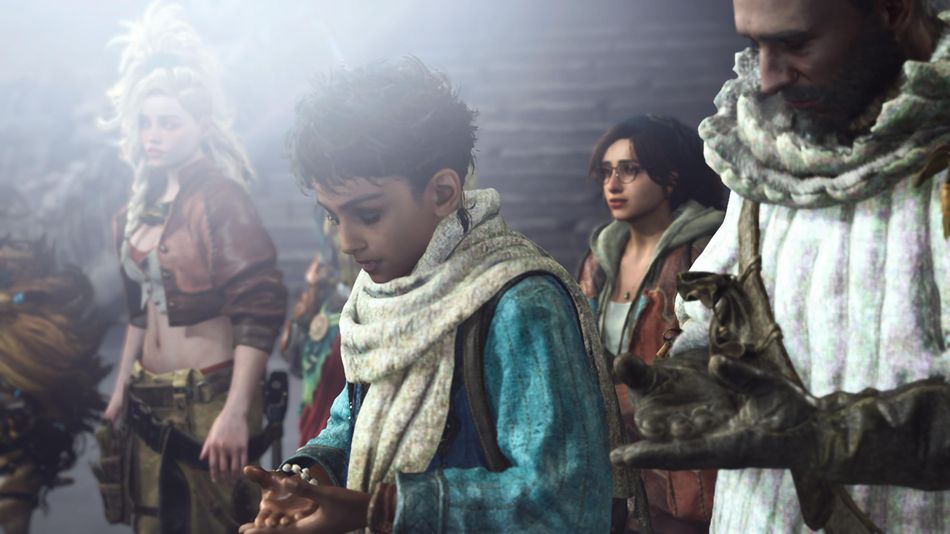
At the very beginning of their journey, the Guild members you're part of will stumble upon a lost boy who remembers very little of his past, and the team will set on a new mission: to help this little fella find his people and the reason why the monsters attacked them in the first place.
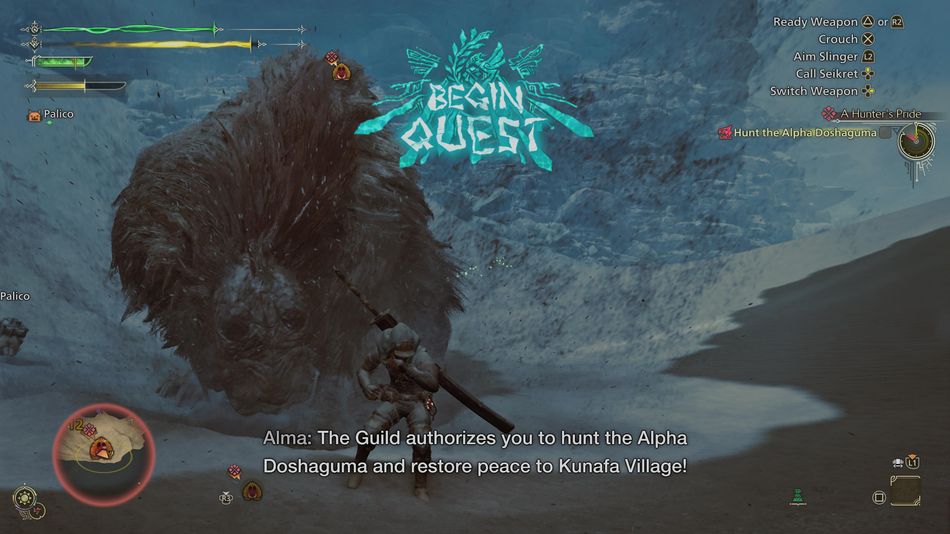
The entire story from that moment will go towards discovering those two mysteries, and as overwhelming as Monster Hunter Wilds is, you might think that the story will show the same symptoms, but it is as straightforward as it comes—you'll follow quest after quest where each one will feature a new monster to fight and the next piece of mystery to discover; as simple as that.
Throughout the story, the game introduces a wide array of new characters, both human and from other races. With so many characters, it’s natural to expect the voice acting might not always hit the mark, but unfortunately, it doesn’t even reach an admirable standard. Considering the Monster Hunter series' reputation and popularity, I had hoped this new instalment would excel in this aspect, but sadly, that’s not the case.
One aspect worth praising is that the protagonist isn't mute and actively participates in conversations, which genuinely enhances the quality of the storytelling. Regardless of the character you create at the start of the game, you'll have several voice options to choose from. At least in this regard, Capcom deserves credit for not taking the easy way out.
Ultimately, the story isn't what will make Monster Hunter Wilds memorable. It feels like the developers included it just to check a box. The real strength of this game lies elsewhere—specifically, in what the title promises: hunting monsters.
Gameplay
If you're a newcomer to Monster Hunter games or any other Capcom RPG, it is highly likely that the game won't click with you at the very beginning. Luckily, I have my share of hours in their latest RPG, Dragon's Dogma 2, so the entire experience wasn't that hard for me at the beginning. However, if you never played such RPGs, expect frustration.
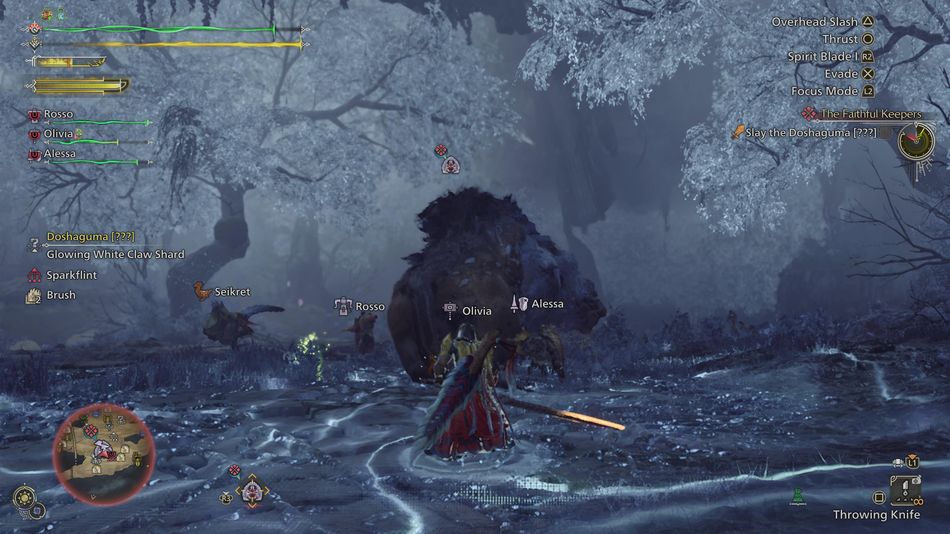
Monster Hunter Wilds is an action RPG with controls that don't fit in any mould created by similar games. For example, if you play the game on PlayStation 5, you'll use the triangle and circle buttons on the controller for light and heavy attacks, while R2 and R1 also work as this combination, with slightly different attack animations.
The L2 button is for locking on the target, but this lock-on only unlocks new moves because you cannot lock on the target at all; you'll have to adjust your camera while fighting manually. And this is all just with one weapon. Every new type of weapon (there are fourteen of them in total) has a different control layout, and this is just one of many overwhelming things in Monster Hunter Wilds.
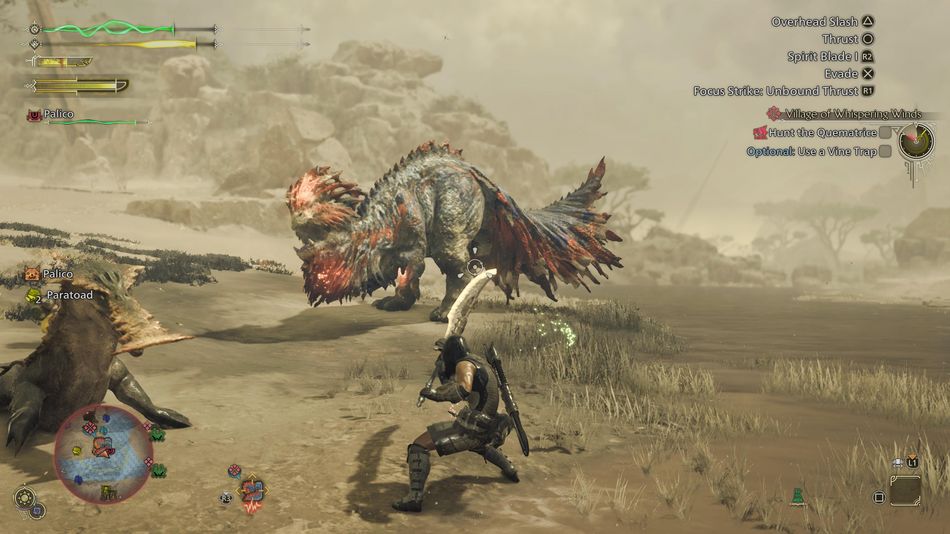
The combat in this game is very unusual and will take a lot of adjusting and a lot of time to get used to it. Some weapons will allow you to block and parry, like the swords with shields, while the others will compensate for those abilities with some special powers. In any case, tinkering with your loadout and using different weapons is probably the biggest highlight of this game.
You'll be able to carry two types of weapons on you all the time—well, not on you, per se, but on your mount, to be perfectly precise. To change weapons while free-roaming or mid-fighting, you'll have to call your mount, switch weapons, and then return to fight.
The weapon options are very versatile, ranging from colossal swords that deal huge damage but are extremely slow to great swords, swords plus shields, bows, bowguns, heavy bowguns, spears, huge maces, and many more that will surely satisfy all players' needs.
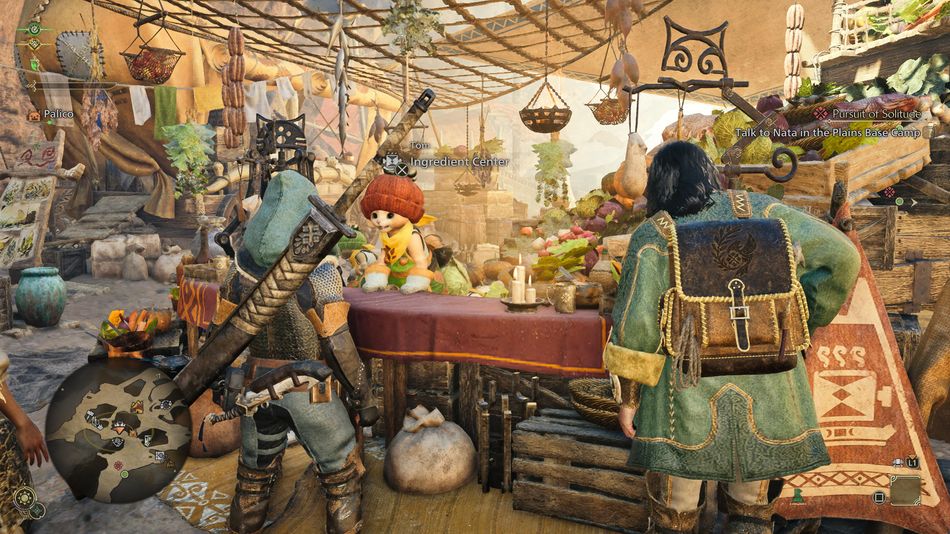
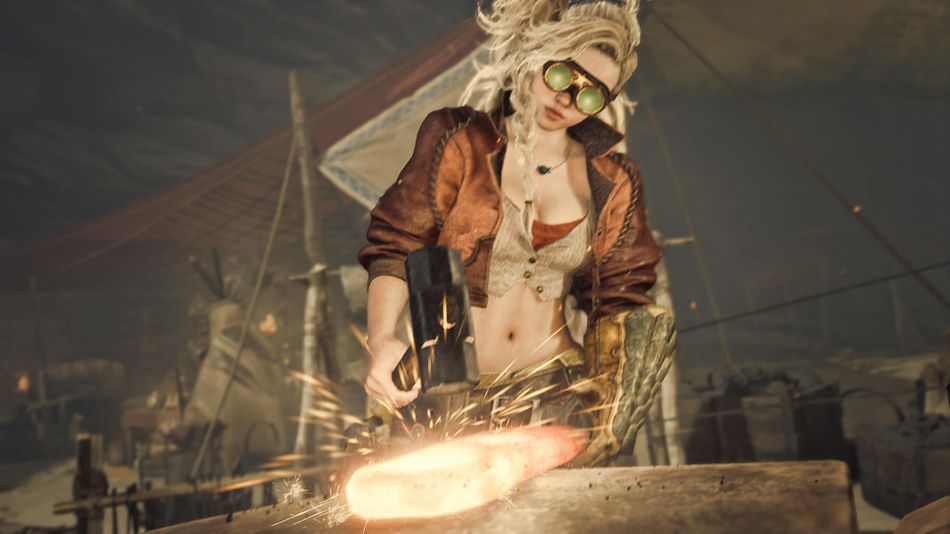
Once you defeat one of the monsters, you'll be able to loot its carcass and gather crucial materials. If you bring those materials to the blacksmith in your camp, she will make you new weapons. Killing new monsters unlocks the new weapon trees, which gives you a lot of new weapon iterations, and this entire system leads to one simple conclusion—the mindless grind.
What some other games do with a quality story pushing you forward to uncover the next piece of mystery, Monster Hunter Wilds does with new monsters and new weapons, throwing you into the endless circle of doing one to get another, and so on.
All weapons can be upgraded too, and that too is a grind in itself. Upgrading weapons will require materials, which, you guess, you can find by killing monsters or gathering them throughout the game's levels.
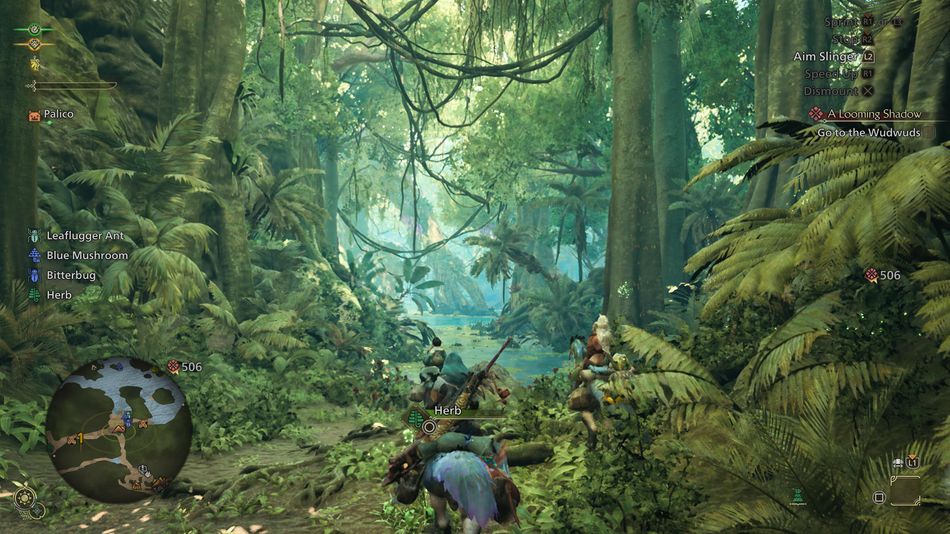
I said earlier that Monster Hunter Wilds is an overwhelming game, but I can assure you, it isn't overexaggeration when I say that you probably haven't seen anything like it before. You'll meet so many mechanics, menus, explanations, and stuff to do in general that you'll definitely lose yourself in all this mess, not knowing what to do next and where to go to do the next task.
The game tries hard to teach you all it has to offer, but for the first five hours or so in the game, the tutorials will still pop up. However, once you get your bearings, the entire experience can be very fun, especially if you play the game as it is intended to be played—with other people.
This, of course, was the feature in all previous Monster Hunter titles, meaning it is nothing new, but one cannot deny that we can never get enough of hunting along with our friends or people from all over the world. When you want to go after a monster, whether through the story or while free roaming, you can choose one of four options: you can choose a recommended lobby where the game will find the players for you based on your level and stats; you can search for a lobby on your own; you can make your own private lobby to play with the people of your choice; and finally, you can play the game in online single player mode.
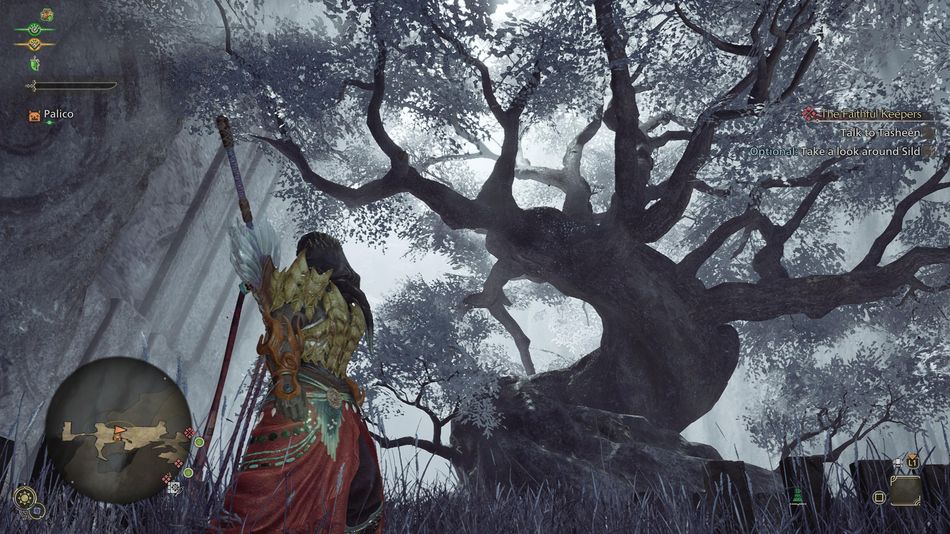
In this mode, you'll be playing alone, but if you ever require the assistance of other players, specifically when facing monsters, you'll be able to send the SOS signal, and the other players will come to your aid. It is a good thing as well that in any moment you can go into your camp and check if other players require your assistance, and if they do, you can join their quests of killing monsters.
Speaking of camps in Monster Hunter Wilds, once you reach a new area, the base camp will be established automatically, but you'll be able to set secondary camps to take care of your gear there and to use them as respawn points if you happen to faint during the encounters.
Each encounter will allow you to faint two times, and if you faint a third time, the quest or the encounter will fail. The encounters with the monsters can be found inside your camp, and you can tackle them by speaking with a particular NPC, or you can find them directly on the map and create your own hunting encounter.
The difference between Monster Hunter Wilds and the previous titles from the series is that this one is much less linear than its predecessors. The game's world features a huge map that is divided into areas or sections. Each area has its own map you can explore, but exploration is pretty much pointless because, in this game, you won't find any mysteries or collectables; the maps will be full of icons showing where to gather certain materials and, of course, where to locate different monsters.
Explaining everything Monster Hunter Wilds has to offer in terms of its versatile gameplay would probably take hours, and no review should be that long. In a nutshell, Monster Hunter Wilds is an extremely enjoyable game, full of new people to meet and new monsters to slay, and if you loved previous titles, this one set everything on a much higher level.
Graphics and performance
Seeing Monster Hunter Wilds for the first time in the trailers was a jaw-dropping experience for me. I thought, is there a way that a game looks like this? The character design, monsters, environments, and everything else were unrealistically beautiful.
To be honest, I couldn't wait to set my hands on the game to see it for myself, but the final result was unfortunately not as appealing as I had hoped it would be. Frankly, graphically speaking, Monster Hunter Wilds hooked us all to the oldest “trailer quality trick” while the real thing is miles away from it.
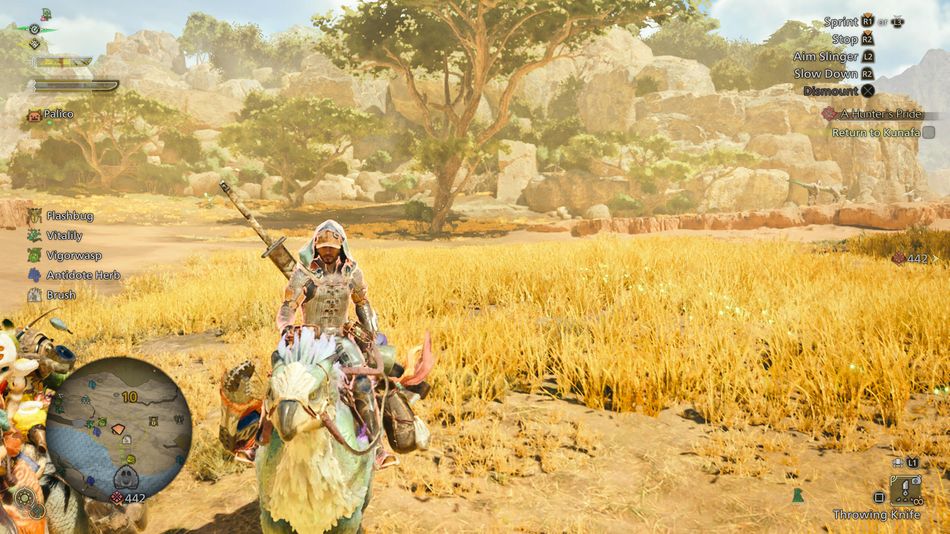
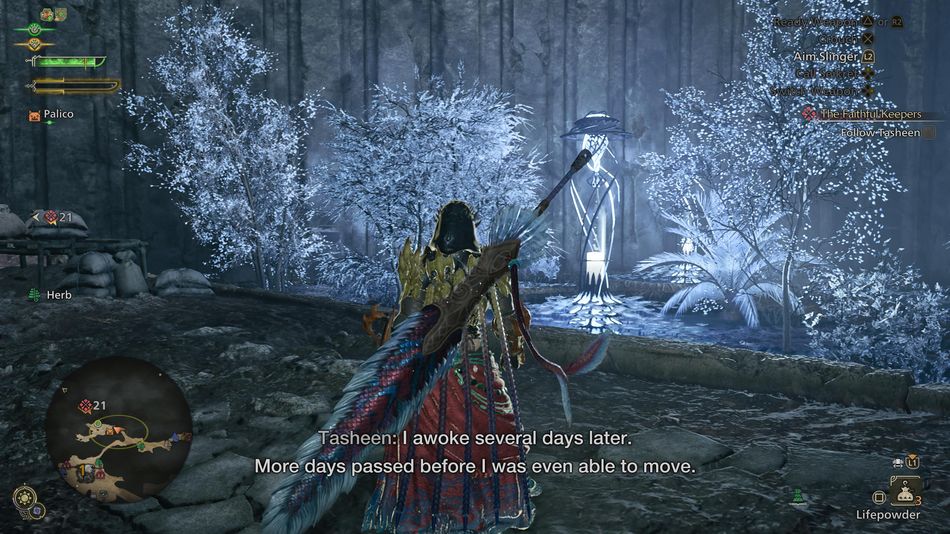
However, to state that Monster Hunter Wilds is an unattractive game would be a lie because the game looks quite good, but it is definitely not as good as it was shown in the trailers. Following the story, you’ll come across many maps and regions with different biomes featuring many strange herbs, small animals, and creatures that give life to this huge world, and all that looks and feels beautiful. The areas range from the lush rainforests to the deserts, snowy peaks and mountains, swamps, and many more, and all of them are showcased beautifully and very stylishly.
Since Monster Hunter Wilds is Capcom’s game, like Dragon’s Dogma 2, it uses their RE Engine, which is well-known for beautiful games it produces; however, I don’t know if it is the engine limitation or the PlayStation 5’s hardware limitation (highly unlikely), but the game on PlayStation 5 looks pretty average, or nothing special, to be more precise.
Character models look nice in cutscenes, but in-game looks are a different story. Everything is so generic, with no extra detail or something that could set the looks of this game apart. The lighting is good, but it seems it lacks modern graphical solutions that could make it even more realistic (something that should definitely be expected from the title of this popularity).
Finally, the biggest letdown in the graphical sense, for me, is that the performance mode on PlayStation 5 looks just awful (I know it’s a strong word, but no other word could be used to stress the importance of this statement). On PlayStation 5, you can play the game in three modes: quality, balanced, and performance. The quality mode offers better fidelity, and the game looks, let’s say, decent in this mode, but the fps can drop way below 30.
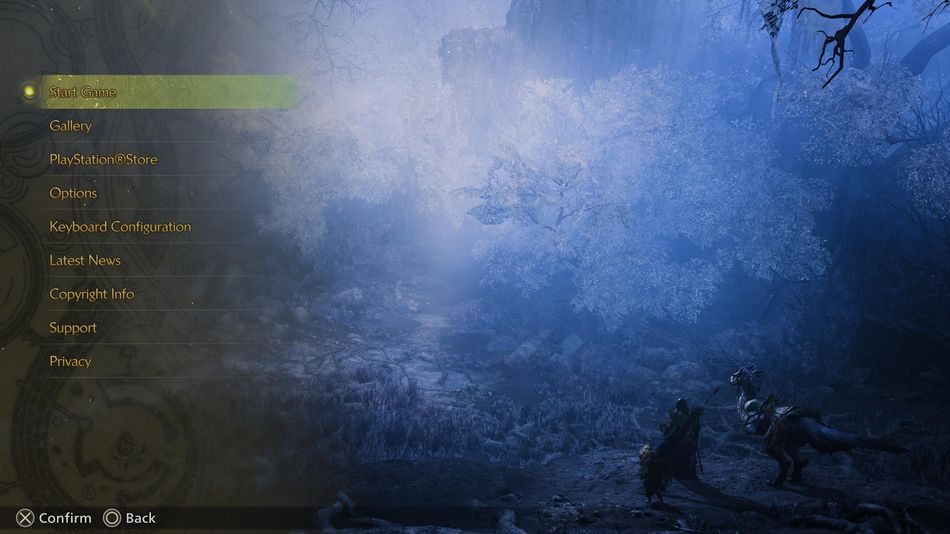
The balanced mode aims to bring a balanced experience with graphics not as good as in the quality mode, but with better performance, aiming for 40 fps. It is all good on paper, but in reality, the game runs very poorly in this mode, sometimes even below 30 fps. And finally, performance mode. It does bring a smooth, 60 fps experience, but unfortunately with the cost of very bad-looking visuals that are definitely not fit for such a game.
Regarding sounds, they are as good as you might’ve expected from a Monster Hunter title: epic music running all the time, even when speaking with the other NPCs, which can be soothing for someone or quite annoying for others. Luckily, I like good music, and it didn’t bother me, which I cannot guarantee will be the case for you. Seriously, though, the music in the game is quite awesome, and it truly complements the atmosphere and somehow fits the locations you find yourself in perfectly.
Unlike the music, the voice presentation, or conversations in general, are quite problematic and full of small bugs. Many times while playing, the voice of the main character or one of their companions will completely disappear. Those issues are mostly fixed with the latest patch, but they’re still present occasionally.
Conclusion
Monster Hunter Wilds is a long-awaited sequel in the long-lasting Monster Hunter franchise and is probably the wet dream of every fanboy of this series. It will deliver everything it promises: the epic hunts full of precisely executed combat where every move and positioning can be of crucial importance, the new locations full of stunning monsters to slay and people to save, and many more things that one can probably forget to mention due to so much the game has to offer, but!
Under the shiny surface, there are some quite concerning things in this game that mustn’t be overlooked at all: the story that simply isn’t convincing enough, the technical difficulties that will probably be fixed in the future, but are here now, and the last but not least, not enough innovations that make Monster Hunter Wilds nothing more than the new instalment in the series. Take everything into consideration and draw the conclusion on your own.
The Good
 Engaging and complex combat system with 14 weapon types
- Deep and rewarding weapon upgrade and crafting mechanics
- Expansive and beautifully designed open-world environments
- Strong cooperative multiplayer experience
- Epic and well-composed music that enhances the atmosphere
The Bad
 Story is weak and feels like an afterthought
- Steep learning curve with overwhelming mechanics and menus
- Performance issues
- Underwhelming graphical fidelity compared to trailers