Trending
The games whose story is based on a mythology are rarely a miss, and if a game treats a mythology we know almost nothing about, it seems like a winning formula.
Bahamut and the WaqWaq Tree is, believe it or not, a game based on Arabian or Middle Eastern mythology, which I must be honest, I didn't know even existed—I know a lot about the pre-Islamic and Islamic periods of Saudi Arabia, but the fact that it actually has a mythology was new for me.
That alone was reason enough to give this game a go and see what it has to offer, and since the studio that worked on the game is from Saudi Arabia too and this is their debut title, it is safe to say that I was genuinely curious about this game.
If you think this is going to be one more of those 1001 Nights stories about Aladdin and the Magic Lamps and whatnot, then I must disappoint you; this game's story is about things that predate everything, even men themselves.
The story of Bahamut and the WaqWaq Tree begins when the new, long-awaited fruit finally hatches and a creature you control comes to existence. Everything will be very confusing at the beginning, all the way until your character dies for the first time, when the story will begin to make more sense.
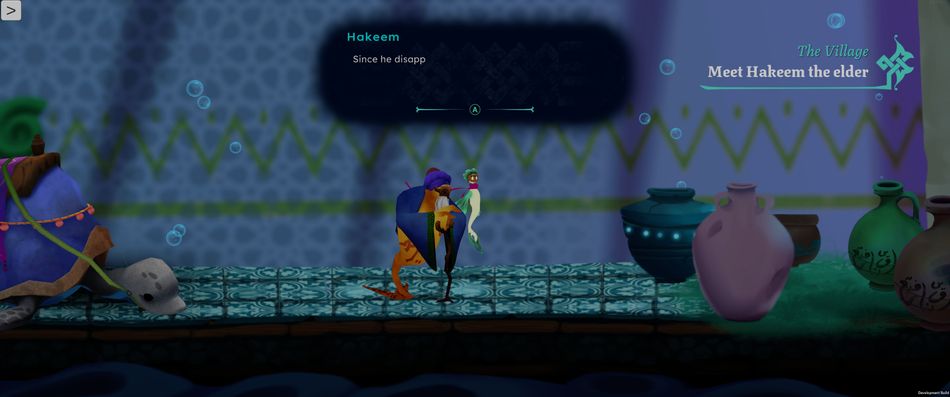
You'll be revived by Bahamut, a spirit of a whale who, along with one more spirit called Falak, serves as a guardian sworn to protect lesser beings (you being one of them) who dwell in the deep waters of the Ma'een Ocean.

Still confused? Fear not; I was confused too because the lore of Bahamut and the WaqWaq Tree is a really grandiose one, and comprehending it will require a great deal of time and effort. Luckily, Bahamut, who is a storyteller as well, has such a deep yet soothing voice while telling the story that will be of huge help in understanding it properly.
Regarding gameplay, Bahamut and the WaqWaq Tree is probably one of the simplest games ever that can be controlled with no more than thumbsticks and maybe one or two buttons on the controller.
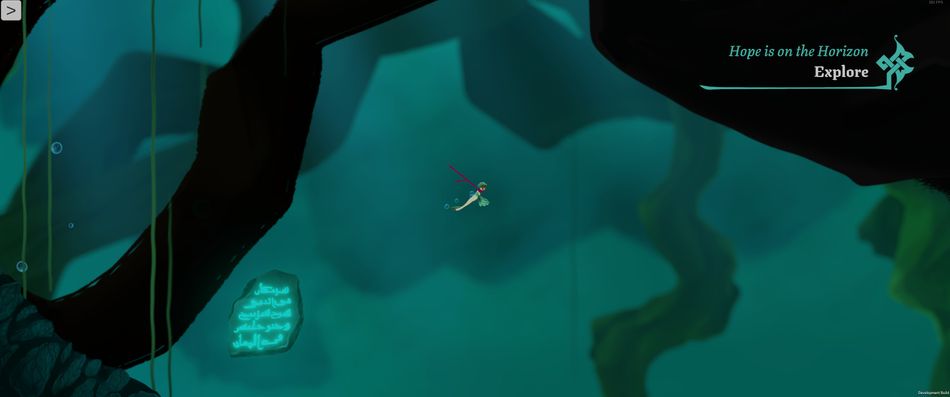
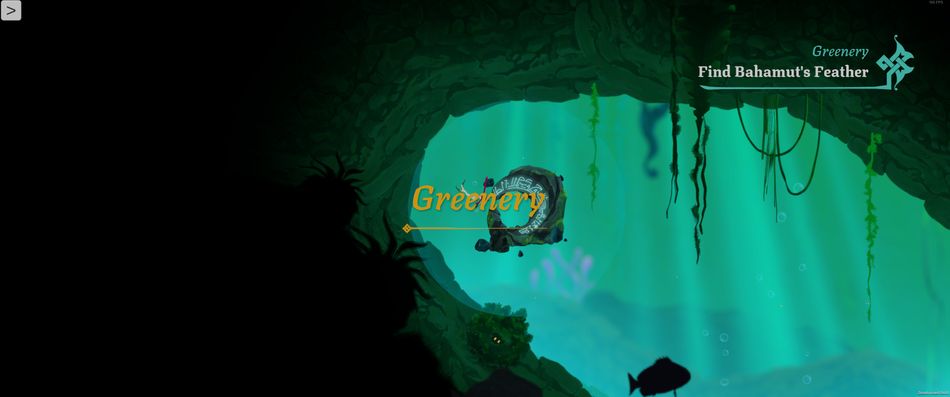
The game takes place inside the ocean, through which your character will swim in a 2D-designed world. The swimming is very responsive and smooth, making the gameplay mechanics very satisfyingly easy to execute.
The gameplay loop is also very simple. All you'll be doing in this game is trying to reach the next safe area where the game will save checkpoints. The main enemies that will try to stop you in this endeavour will be Dujaa, dark purple dots responsible for corrupting the Ma'een Ocean.
Your main goal will be to reach the source of corruption and deal with it, and in this task, you'll be aided by the light given to you by the guardians, along with some other powers you'll get along your journey.
Even though the gameplay objectives look too simple, as the game progresses, the areas will become tougher, featuring more alternate paths that will work as decoys, and some areas gave me real trouble while trying to solve them and safely reach the checkpoint.
Your main weapon will be the light, which has a limited charge, and as long as it is deployed, you cannot be harmed. Now, you'll have to figure out the way to cover distances while keeping enough light to reach the next checkpoint, and that's pretty much everything you'll do in this game.
As interesting and engaging as this mechanic actually is, it very quickly becomes too boring and tedious, and that's pretty much the main problem with this game.
Graphically speaking, Bahamut and the WaqWaq Tree is a cute game with visuals that are not a match for today's standards, but the art style is somehow catchy and looks soothing.
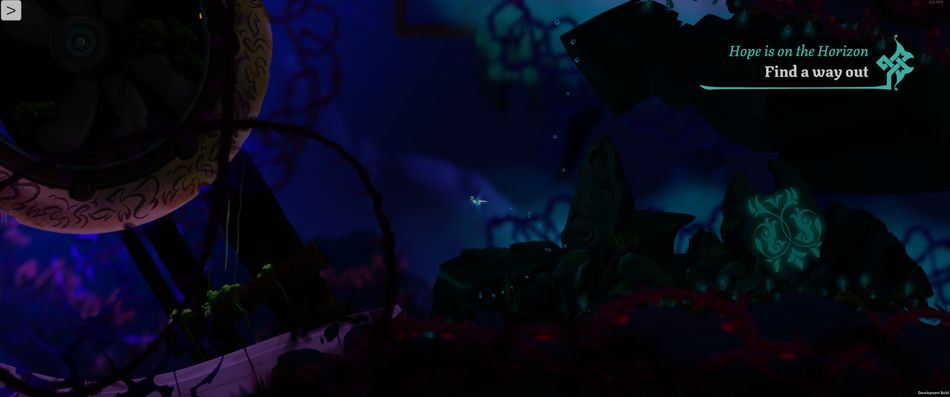
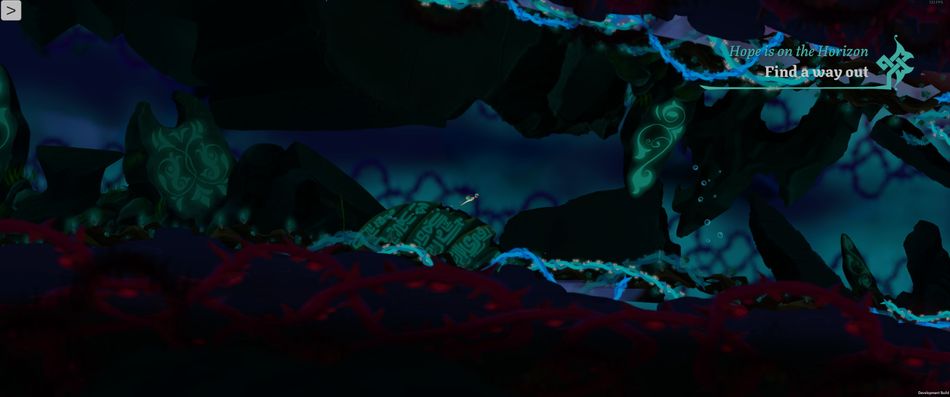
The water effects look good as well, all with the bubble trail as your character cuts through the vastness of the ocean deeps. The water's appearance—whether it's the crystal-clear ocean untouched by corruption or the darkened depths tainted by the spreading scourge—is stunningly beautiful and surprisingly realistic, even though the game's overall visual style leans more toward a cartoon aesthetic.
As soothing as the visuals are, the accompanying soundtrack also brings a sense of calm to the gameplay. In this regard, the developers have done an excellent job blending these two elements. The sound design is impressive, and with its subtle storytelling, it helps create a rich and immersive audiovisual experience.
Conclusion
Bahamut and the WaqWaq Tree is a 2D adventure rooted in obscure Arabian mythology, featuring a mysterious and intriguing story. While its minimalist and occasionally repetitive gameplay may not seem particularly fun at first glance, the gameplay loop proves surprisingly engaging, offering moments of difficulty and challenge that help maintain the player's attention.
With its distinctive art style and an audiovisual presentation that at times feels almost therapeutic, this game can be a very good way to pass the time—whether you're waiting for a major release, looking to unwind from more demanding titles, or simply taking a break after a long day at work.
The Good
 Unique and mysterious story based on obscure Arabian mythology
- Soothing and immersive audiovisual presentation
- Simple and smooth controls
- Strong voice acting and storytelling through narration
The Bad
 Minimalist and repetitive gameplay
- Quickly becomes tedious
- Limited gameplay mechanics and objectives
- Visuals not up to modern standards